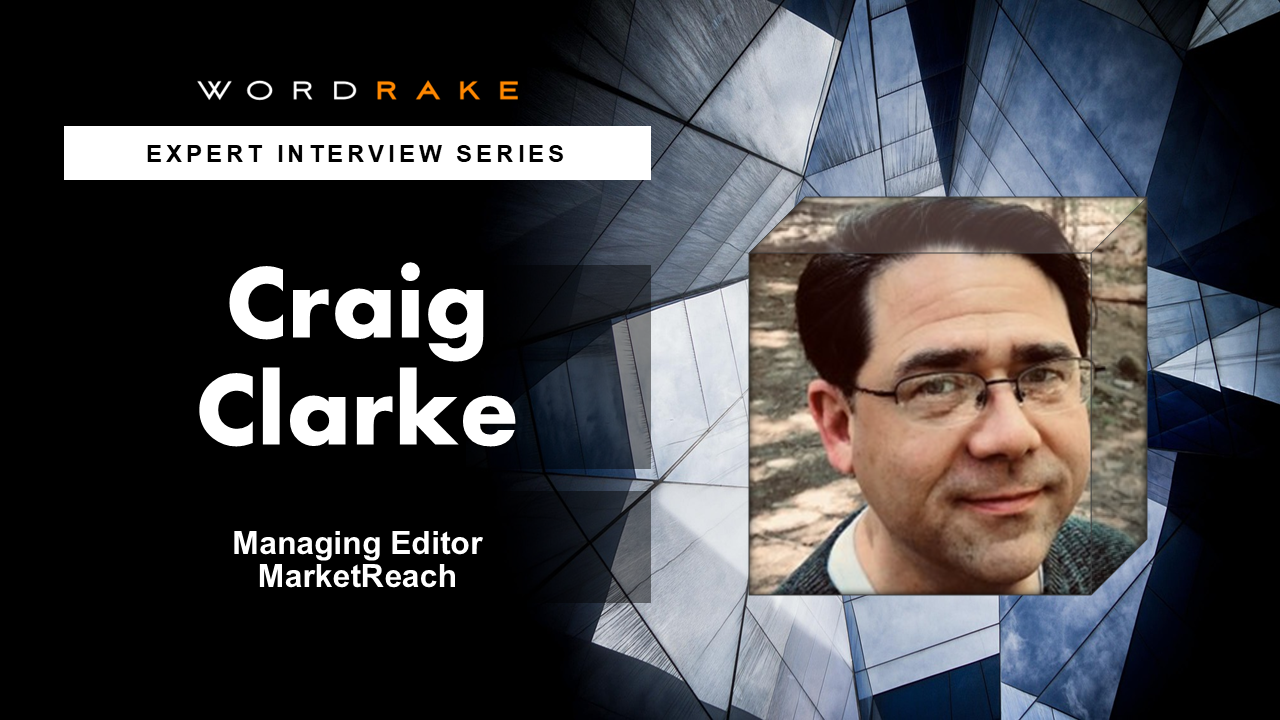
As an avid reader and the Managing Editor at MarketReach, Craig Clarke is no stranger to writing and editing nuances. His self-taught skills led him to edit written works spanning various topics and genres. With over 20 years of experience bringing clarity and intention to his client's projects, Craig offers wisdom about the ins and outs of his industry and changes he wants to see in the future.
What prompted your interest in editing?
I’ve always found typos, etc., in published works, even in school. I would point out people’s mistakes to them, unbidden. For some reason, they didn’t appreciate that. It wasn’t until much later that I found out that some people would pay you for it—and not take a swing at you.
What do you love about your job? What do you not love?
I love making a writer’s intentions clear. The main problem most writers have is that what they mean to write is not what ends up on the page. When writing needs to be churned out quickly, the first draft becomes “good enough.” So, when I’m lucky enough to receive one of these drafts, I’m able to turn what the writer wrote into what they meant to write. It’s the best part of my job.
Are editors able to edit their own writing?
Everyone needs an editor, even other editors. It’s a completely different process from writing. Editors are only as able to edit their own writing as other writers are. As writers, we tend to think our intentions made it to the page, and the extra eyes are there to keep us humble. They’ll catch something, I guarantee.
Why do writers and editors talk about "killing your darlings"? What does it mean, and why should you do it?
Killing your darlings means getting rid of those parts you’re most proud of—a sentence or turn of phrase that feels particularly inspired or insightful—but that don’t match the rest of the piece. The fact that it stands out means it breaks the flow. It has to go, for the greater good.
Keep it in a separate document, though. It might fit in somewhere else, and you can always post it as a pithy insight.
What are your writing and editing pet peeves?
My main pet peeve is when people use “and I” or “and myself” in the situations where “and me” is grammatically correct. For some reason, that’s the one that eats at me, probably because it’s considered “correct.” I even wrote an article on LinkedIn about it to explain why it’s actually OK to say.
What are the qualities of good writing? Does it differ depending on genre?
All writing benefits from clarity. Clarity is courtesy. Clear writing is easy to read, and everyone appreciates that. It doesn’t have to be stripped of all personality, but it does need to be streamlined. And you need an editor for that. An editor can tell what needs to stay and what can go without affecting the writer’s voice.
I’ve worked with writers who didn’t want me to mess with their comma placement, and others who felt their wordiness was their “voice,” but I’ve found that if you catch them at the right moment and explain your reasoning, they’ll often see your side.
How does AI change things for professional editors? Is there still value in hiring a human?
The important thing to remember about GenAI is that it generates text. It’s well-punctuated (yes, the em dashes are used correctly), grammatical, and has few misspellings. But since it produces text based on the most likely union of certain words, it is average by definition.
It really doesn’t understand the editing process. If you can ask it to improve a piece, but it is more likely to rewrite than make detailed selections. This requires a human. A human will look at a piece of writing, compare it to the best writing they’ve seen (as opposed to every writing they’ve seen), and work to make it better.
What tech tools do you use in your work?
PerfectIt really helps with the consistency requested by clients. I like that it shows the inconsistencies—such as hyphenating or not hyphenating “real time” in different locations—and then allows you to choose whether to change each occurrence. (Because sometimes you hyphenate, and sometimes you don’t.)
Are you willing to edit AI derived writing? Why?
I’m surprised by this question because I’ll edit anything you give me. AI produces a first draft, so someone needs to edit it, and why not me? I understand that writing is hard work, and sometimes the brain gets tired and needs a little help, so I’m not against AI except for when people let it think for them.
Are there any specific attributes in a document that scream "a bot wrote this" to you?
“In the fast-moving [fill in the blank] industry….” is the big one, but “It’s not just about [this]—it’s also about [actual topic]!” is a close second.
Get an in-house editor at your fingertips for 40 cents a day.
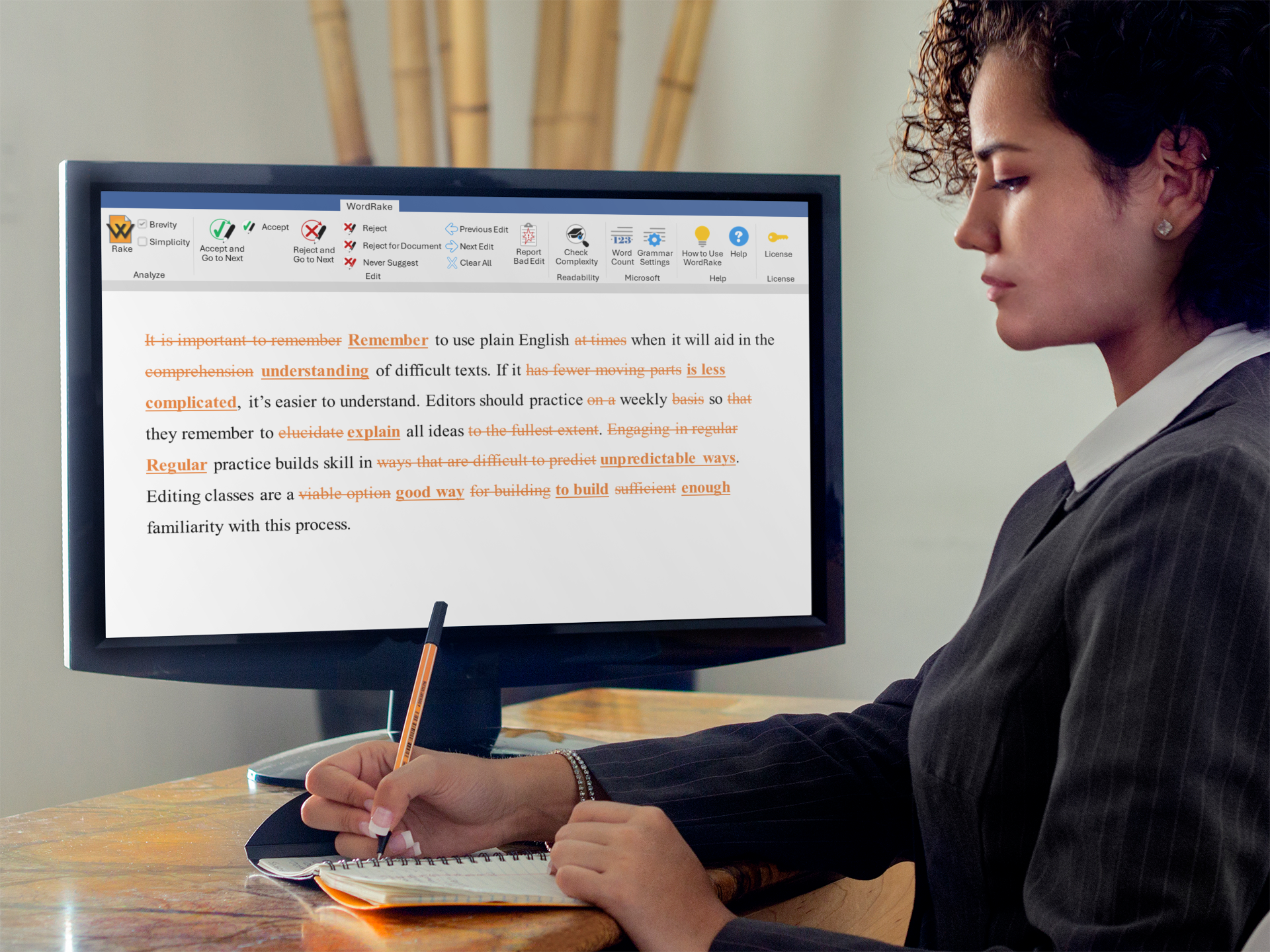
WordRake editing software is a second pair of eyes to help polish your writing.

Who should hire an editor?
Any writer who wants their work to be the best it possibly can.
If someone is already a good writer, why would they need an editor?
Good writing is subjective. If your writing always matches your intention, maybe you don’t need an editor. But how often does that happen? Most of us need someone else to look at it objectively, from the reader’s point of view. A reader can tell there’s something missing. An editor will help you find it.
What should you do if you can't afford a professional editor?
This is a real consideration. Editing is an investment, and a good editor is not cheap. Some writers swap with other writers to look over each other’s work in a sort of barter arrangement. This can at least catch some of the most embarrassing typos before publication.
What is the most underrated punctuation mark? Why?
The interrobang (‽) belongs on keyboards. Modern life presents many opportunities to be shocked and confused, and it’s the perfect ending to a situationally appropriate “WTF‽” Why settle for the weaker two-mark (?!) substitute?
What are your thoughts about the Oxford comma?
I use it. It adds clarity. I know that some use it “when it’s needed,” but who is fit to judge that for every reader? Plus, it means stopping your editorial flow at every list and asking that question. What a waste of time. Just drop in the comma and move on. There are bigger problems to be solved.
In my experience, editors are pro–Oxford comma, and writers are anti. They don’t want to be bothered. I also understand why the AP wanted to save ink, but that’s hardly an issue now.
What do you wish would change about the way people are taught to write?
People learn to write in an academic setting, but few people read in one. Aiming for a word count is a huge fault of our writing education. This makes it appear that more words are better, when fewer words more often result in conciseness and clarity, the tools for easier understanding. Far too often, people don’t write to be read. They write to be finished.
About Craig Clarke
Craig Clarke has 20+ years of proofreading and copyediting experience across various forms of writing: fiction, education, history, medical, technology, literature, mathematics, and marketing.
An autodidact with eclectic interests, he reads widely and voraciously, weaving nonfiction on legal history, behavioral economics, and astrophysics among the crime and horror novels he prefers.
It all feeds the work.
Keep up with his shenanigans on LinkedIn.
About the Editor Interview Series
WordRake is an automated editing add-in for Microsoft Word and Outlook. Our editing algorithms are created by linguists and subject matter experts to offer nuanced suggestions to improve clarity and cut wordiness in your documents. But we know that software is only the start of your editing process! To help writers understand more about editing and the considerations that go into it, we’ve enlisted several of our favorite professional editors to share their experience and wisdom. Learn from the best about the importance of great editing—and then go try WordRake for yourself!
This isn't spelling and grammar software. This is editing software to improve brevity and simplicity.
Succinct writing for 40 cents a day.