
Looking for clear and concise editing? Try WordRake on select documents now!
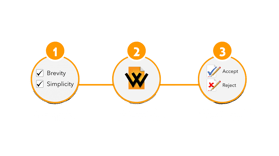
Here’s how it works:
THE 2023 ANNUAL REPORT OF THE BOARD OF TRUSTEES OF THE FEDERAL OLD-AGE AND SURVIVORS INSURANCE AND FEDERAL DISABILITY INSURANCE TRUST FUNDS
The Old-Age, Survivors, and Disability Insurance (OASDI) program makes monthly income available to insured workers and their families at retirement, death, or disability.
The OASDI program consists of two consists of two has two parts.
Retired workers, their families, and survivors of deceased workers receive monthly benefits under the Old-Age and Survivors Insurance (OASI) program.
Disabled workers and their families receive monthly benefits under the Disability Insurance (DI) program.
The Social Security Act established the Board of Trustees to oversee the financial operations of the OASI and DI Trust Funds.
The Board is composed of is composed of consists of six members.
Four members serve by virtue of their by virtue of their because of their positions in the Federal Government: the Secretary of the Treasury, who is the Managing Trustee; the Secretary of Labor; the Secretary of Health and Human Services; and the Commissioner of Social Security.
The President appoints and the Senate confirms the other two members to serve as public representatives.
These two positions are currently currently vacant.
The Deputy Commissioner of the Social Security Administration serves as Secretary of the Board.
The Social Security Act requires that the Board, among other duties, report annually annually yearly to Congress on the actuarial status and financial operations of the OASI and DI Trust Funds.
The 2023 report is the eighty-third such report.
The intermediate (best estimate) assumptions for this report were set in December 2022.
The Trustees will continue to monitor monitor track future developments and modify modify change projections in later reports as appropriatereports as appropriatereports.
More than 3 years More than 3 years Over 3 years after the start of the COVID-19 pandemic, the acute stage of the pandemic appears to appears to seems to be over, but the Trustees expect there will be residual effects on the population and the economy for years to come.
Since the assumptions for last year's report were set, the Trustees have reassessed their expectations for the economy in light of economy in light of economy given recent developments, including updated data on inflation and output, and have revised the levels of gross domestic product (GDP) and labor productivity by about 3 percent over the projection period.
Assumptions for growth are largely unchanged after the first 10 years of the projection period.
The intermediate (best estimate) assumptions for this report were set in December 2022.
The Trustees will continue to monitor monitor track developments and modify modify change projections in later reports.
At the end of 2022, the OASDI program was providing benefit payments to providing benefit payments to giving benefit payments to approximately approximately about 66 million people: 51 million retired workers and dependents of retired workers, 6 million survivors of deceased workers, and 9 million disabled workers and dependents of disabled workers.
Over the course of the yearOver the course of the yearDuring the year, an estimated 181 million an estimated 181 million about 181 million people had their earnings covered by Social Security and paid payroll taxes on those earnings.
The total cost of the program in 2022 was $1.244 billion.
Total income was $1.222 billion, which consisted of consisted of included $1.155 billion in non-interest income and $66 billion in interest earnings.
Asset reserves held in special issue U.S. Treasury securities decreased decreased went down from $2,852 billion at the beginning of the year to $2.830 billion at the end of the year.
Under the Trustees' intermediate assumptions, Social Security's total cost is projected to be higher than its total income in 2023 and all subsequent yearsall subsequent yearsall later years.
Total cost began to be higher than total income in 2021.
Social Security's cost has exceeded its non-interest income since 2010.
To illustrate the actuarial status of the Social Security program as a wholeprogram as a wholeprogram, the operations of the OASI and DI Trust Funds are often shown shown on a combined basis as OASDI.
However, by law, the two funds are separate entities and therefore therefore the combined fund operations and reserves are hypothetical.
The combined reserves are projected to decrease decrease go down from $2,830 billion at the beginning of 2023 to $590 billion at the end of 2032, the last year of the short-range period.
The reserves of the combined OASI and DI Trust Funds along with projected program income are sufficient to cover are sufficient to cover are enough to cover projected program cost over the next 10 years under the intermediate assumptions.
However, the ratio of reserves to annual cost is projected to decline from 204 percent at the beginning of 2023 to 96 percent at the beginning of 2029 and remain below 100 percent for the remainder remainder rest of the 10-year short-range period.
Because this ratio falls below 100 percent by the end of the tenth projection year, the combined OASI and DI Trust Funds fail the Trustees' test of short-range financial adequacy.
Considered separately, the OASI Trust Fund fails this test, but the DI Trust Fund satisfies the test.
For last year's report, the combined reserves were projected to be 211 percent of annual cost at the beginning of 2023 and 57 percent at the beginning of 2032.
Long-Range Results (2023-2097)
The DI program continued to have low levels of disability applications and benefits awarded through 2022.
Disability applications have decreased substantially have decreased substantially have gone down a lot since 2010, and the total total number of disabled-worker beneficiaries in current payment status has been falling since 2014.
OASDI cost has been generally increasing much more rapidly than non- interest income since 2008 and is projected to continue to do so through about 2040.
In this period, the retirement of the baby-boom generation is increasing the number of beneficiaries much faster than the increase in the number of covered workers, as subsequent generations as subsequent generations as later generations with lower birth rates replace the baby-boom generation at working ages.
Between about 2040 and 2055, OASDI cost and non-interest income are projected to generally increase increase go up at more rates that are mostly similar to mostly similar to much like the cost rate (the ratio of program cost to taxable payroll) roughly stabilizes, reflecting the return to birth rates above 2 children per woman between 1990 and 2008.
Between 2055 and 2078, OASDI cost is projected to increase increase go up significantly faster than income because of the period of historically low birth rates starting with the recession of 2007-09.
From 2078 to 2097, cost is projected to grow somewhat slower than income, as birth rates are assumed to return to a level of 2 children per woman for 2056 and thereafter.
If the assumptions, methods, starting values, and the law had all remained unchanged, the actuarial deficit would have increased have increased have gone up to 3.48 percent of taxable payroll, and the unfunded obligation would have increased have increased have gone up to 3.29 percent of taxable payroll and $21.2 trillion in present value due to the change in the valuation date and the extension of the valuation period through an additional year, 2097.
The actuarial deficit increased increased went up significantly in this year's report primarily due to recent economic experience and changes in near-term economic assumptions, as described in section IV.B.6 of this report.
In particular, the In particular, the The level of potential GDP is assumed to be about 0.9 percent lower than the level that was that was estimated in last year's report for 2020, widening to approximately approximately about 3.0 percent lower by 2026 and for all years thereafter.
This shift was made as the Trustees lowered the levels of GDP and total economy labor productivity in response to recent economic developments, including higher-than-expected inflation rates and lower-than-expected output growth.
To illustrate the magnitude of the the magnitude of the the amount of 75-year actuarial deficit, consider that, for the combined OASI and DI Trust Funds to remain fully fully solvent throughout the 75-year projection period ending in 2097: (1) revenue would have to increase increase go up by an amount equivalent to an immediate and permanent payroll tax rate increase of 3.44 percentage points1 to 15.84 percent beginning in January 2023; (2) scheduled benefits would have to be reduced by an amount equivalent to an immediate and permanent reduction of 21.3 percent applied to all current and future beneficiaries effective in January 2023, or 25.4 percent if the reductions were applied only to those who become initially initially eligible for benefits in 2023 or later; or (3) some combination of these approaches would have to be adopted.
Under the intermediate assumptions, the projected hypothetical combined OASI and DI Trust Fund asset reserves become depleted and unable to pay scheduled benefits in full on time in 2034.
At the time of depletion of these combined reserves, continuing income to the combined trust funds would be sufficient to pay be sufficient to pay be enough to pay 80 percent of scheduled benefits.
The OASI Trust Fund reserves are projected to become depleted in 2033, at which time OASI income would be sufficient to pay be sufficient to pay be enough to pay 77 percent of OASI scheduled benefits.
DI Trust Fund asset reserves are not projected to become depleted during the 75-year period ending in 2097.
The Trustees recommend that lawmakers address the projected trust fund shortfalls in a timely way in a timely way promptly in order in order to phase in necessary changes gradually and give workers and beneficiaries time to adjust to them.
Implementing changes Implementing changes Making changes sooner rather than later would allow more generations to share allow more generations to share let more generations share in the needed increases in revenue or reductions in scheduled benefits.
Social Security will play a critical role in the lives of 67 million beneficiaries and 180 million covered workers and their families during 2023.
With informed discussion, creative thinking, and timely legislative action, Social Security can continue to protect future generations.
The U.S. Department of Education (Department) has been charged with allocating billions allocating billions assigning billions of dollars to assist assist help States, K-12 schools, school districts, and institutions of higher education in meeting their needs and the needs of their students impacted impacted affected by the coronavirus (COVID-19) The Office of Inspector General (OIG) has been charged with ensuring that that these vital vital important funds are used as required and reach the intended recipients, and with investigating misuse, theft, and other criminal activity involving these funds.
Three measures were signed into law providing the Department with providing the Department with giving the Department more than $280 billion to assist assist help States, K-12 schools, school districts, and institutions of higher education in meeting their needs and the needs of their students impacted impacted affected by the coronavirus pandemic.
Since 2020, the OIG has been conducting audits and reviews of programs, grants, requirements, and flexibilities established under these laws.
During this reporting period, we issued a series of a series of reports on audits that seek to determine whether selected SEAs have adequate oversight processes in place to ensure that (1) LEAs' ARP ESSER plans meet applicable requirements and (2) LEAs use ARP ESSER funds in accordance with in accordance with under applicable requirements and their approved plans.
ARP ESSER funds were established to help SEAs and LEAs safely reopen and sustain the safe operation of schools and to address the impact of the coronavirus pandemic on students.
Each SEA was required to submit was required to submit had to submit a plan to the Department's Office of Elementary and Secondary Education (OESE) for approval that explained how it would use ARP ESSER funds.
SEAs were required to allocate were required to allocate had to allocate not less than 90 percent of the SEA's total ARP ESSER allocation to LEAs.
LEAs receiving ARP ESSER funds were to develop and submit to the SEA a plan for their use of ARP ESSER funds, and meet requirements related thereto.
The first audit completed in this series involved the State of Washington. As a part of this audit, we selected two Washington LEAs for review: the Granger School District and Seattle Public Schools. You will find the results of our audit below.
Washington's Oversight of Local Educational Agency ARP ESSER Plans and Spending
Our audit found that the Washington Office of Superintendent of Public Instruction (Washington) did not have an adequate review and approval process to ensure that ensure that make sure LEA ARP ESSER plans met all applicable requirements.
As a result, the As a result, the The public did not have sufficient have sufficient have enough insight into how the LEAs planned to spend ARP ESSER funds.
Washington was required to ensure was required to ensure had to ensure that LEAs submitted ARP ESSER plans that were complete and timely; however, we found that Washington did not ensure LEAs' compliance with all Federal requirements and guidance for creating transparent and understandable plans.
During the audit, Washington was responsive to was responsive to responded to the issues we identified and initiated initiated started corrective action to ensure that ensure that make sure Federal requirements and guidance were met.
We also determined that Washington's monitoring monitoring tracking of LEAs could be strengthened to provide additional additional more assurance that LEAs used ARP ESSER grant funds for allowable purposes and followed applicable regulations.
Washington used its iGrants system to approve LEA ARP ESSER grant budgets and grant applications and to process LEA ARP ESSER claims for reimbursement.
However, the claim reimbursement process did not include collecting or reviewing any expenditure-supporting documentation, and we identified one expenditure expenditure spending that did not follow procurement requirements.
Further, although Washington used its Consolidated Program Review (CPR) process to review selected LEA expenditures expenditures spending for compliance with Federal education program requirements, its CPR process was not modified modified changed to consider the higher risk associated with ARP ESSER expenditures expenditures spending to ensure selection selection choice of APR ESSER expendituresexpendituresspending.
As a result, As a result, Washington may not have sufficient have sufficient have enough assurance that ARP ESSER expenditures were expenditures were spending was allowable.
Based on our findings, we made three recommendations: (1) that Washington take appropriate appropriate corrective actions for LEAs with approved ARP ESSER plans so that that these plans meet all applicable requirements; (2) that Washington be required to document be required to document have to document its review and approval of ARP ESSER plans for LEAs that have not yet submitted their plans, once they have been submitted, to ensure that ensure that make sure they comply with all program comply with all program follow all program requirements; and (3) that Washington develop and implementdevelop and implementcreate, for both the reimbursement and monitoring monitoring tracking processes, protocols to sample LEA expenditures expenditures spending charged to ARP ESSER, and to review supporting documentation, including procurement process documentation, to ensure that ensure that make sure applicable Federal, State, and local requirements are met.
Washington officials neither agreed nor disagreed with our findings but agreed with our recommendations.
Local Educational Agencies' Uses of Elementary and Secondary School Emergency Relief Funds for Technology
The purpose of this report was to identify The purpose of this report was to identify This report identified and describe LEAs' uses of ESSER funds for technology purposes.
We surveyed a nationwide sample of LEAs about their experiences with using ESSER funds to purchase to purchase to buy educational technology to continue student instruction during the coronavirus, specifically the (1) types of educational technology that LEAs purchased with their ESSER funds, (2) challenges that LEAs experienced when using ESSER funds for educational technology, and (3) impact the educational technology had on student learning.
The survey provided important information.
LEAs nationwide generally reported using ESSER funds to purchase to purchase to buy educational technology to continue student instruction during the coronavirus.
We estimated that 92 percent of LEAs used ESSER funds to purchase to purchase to buy hardware, software, connectivity, and related products or services to continue instruction during the coronavirus.
We noted that 93 percent of LEAs used ESSER funds to purchase to purchase to buy hardware to continue instruction.
ESSER funds were also used for connectivity (70 percent), software (66 percent), and other products and services (43 percent), such as training.
Except for hardware, we identified notable differences between traditional and charter LEAs' responses for how ESSER funds were used to purchase to purchase to buy educational technology.
Traditional LEAs were more likely to use ESSER funds to purchase to purchase to buy connectivity and charter LEAs were more likely to use ESSER funds to purchase to purchase to buy software and other products and services.
Further, we noted through our analyses that urban LEAs, high-poverty LEAs, and small LEAs were more likely to use ESSER funds to purchase to purchase to buy educational technology when compared to their counterparts.
LEAs reported that they initiated initiated started or expanded programs that provided all students in their schools or districts access to digital devices for schoolwork and purchased purchased bought hotspots that resolved or mitigated the challenges of ensuring that ensuring that making sure all students and teachers had adequate internet access.
LEAs nationwide reported on challenges that that they had to address using educational technology purchased purchased bought using ESSER funds, including resolving or mitigating challenges they faced while continuing student instruction during the coronavirus, and experienced when using ESSER funds to purchase to purchase to buy educational technology.
We then asked LEAs how they resolved or mitigated the challenges they experienced.
LEAs most frequently frequently often reported experiencing challenges due to (1) shifting the method of instruction to remote, hybrid, or in-person; (2) ensuring students and teachers had adequate internet access; (3) purchasing purchasing buying educational technology; and (4) maintaining or repairing educational technology.
We asked LEAs about any ongoing or future challenges that that they anticipated anticipated expected related to using ESSER funds for educational technology.
LEAs most frequently frequently often reported the need to sustain ongoing costs when ESSER funds are no longer available as an anticipated anticipated expected future challenge.
Our survey revealed that ESSER-funded technology enabled LEAs nationwide to continue instruction remotely during shutdowns due to the coronavirus.
We asked LEAs to provide their opinions about the degree (i.e., great, some, or none) to which ESSER-funded technology enabled their schools to provide remote instruction for different student populations.
We estimate that 68 percent of LEAs were enabled, to a great degree, by ESSER-funded technology to provide remote instruction for provide remote instruction for remotely instruct the general student population.
Further, LEAs most frequently frequently often reported being enabled by ESSER-funded software, to a great degree, then hardware and connectivity to provide remote instruction.
We estimate that 46 percent of LEAs were able to address were able to address addressed the academic impact of lost instructional time because ESSER-funded technology, to a great degree, facilitated activities facilitated activities helped with activities during the 2019-2020 school year.
This percentage increased increased went up to 50 percent of LEAs during the 2020-2021 school year.
The report was informational and did not include any recommendationsdid not include any recommendationsincluded no recommendations.
The American Community Survey (ACS) is the largest continuous household survey in the United States, providing a wealth of information about the economic, social, and demographic characteristics characteristics features of personspersonspeople, as well as housing characteristicscharacteristicsfeatures.
One goal of the ACS
is to serve as a cost-effective vehicle for collecting information required by law, regulation, or executive order on behalf of Federal agencies or at the direction of Congress.
In conducting the ACS, the U.S. Census Bureau leverages its existing infrastructure and data collection expertise expertise knowledge on behalf of the Federal Government.
Like the decennial census long form before it, the ACS provides comprehensive and representative statistical information about large and small communities on a variety of important topics-all while protecting respondents' confidentiality.
In addition, because the ACS is a continuous survey, the data is published annuallyannuallyyearly, providing more timely information than the once-per-decade long form.
The value of the ACS lies in its ability to provide statistical information representing large and small communities and demographic groups across the Nation that can be used by governments, businesses, and individuals to make better decisions.
This ability depends upon depends upon depends on sufficiently large samples from these communities, which in turn in turn depends on the mandatory mandatory required nature of the survey.
About 3.5 million households are sampled every year for the American Community Survey, and
it takes respondents a total of a total of about 2.4 million hours per year to answer the survey.
In exchange, the Nation acquires uniquely comprehensive, representative, topical, and timely data about its communities that serves as an essential component component part of the information infrastructure relied upon relied upon relied on by decision makers through out the country.
What would happen to the quality of decision making if the ACS were less comprehensive, representative, topical, or timely?
The answer depends upon depends upon depends on the specific use to which the data would be put and require speculation about what, if any, , if any, data would be used instead.
Still, Canada's recent experience in moving from a mandatory to a voluntary survey provides some insight into the value of a comprehensive, representative, topical, and timely survey, and what happens when those qualities are compromised.
After it became voluntary, the Canadian survey yielded much lower response rates, resulting in information that less comprehensively and reliably covered the small areas of Canada-and at a higher cost.
Canadian decision makers were left to use out-of-date data that did not necessarily represent the specific geographic areas in question.
ACS data is uniquely tailored to help guide myriad specific decisions across myriad specific decisions across many specific decisions across the country, making government more intelligent, businesses more competitive, and the public more informed.
As a tool for smarter government, ACS data offers evidence to help government operate betteroperate betterrun better.
Federal agencies rely on the ACS to help them make operational decisions, including managing and evaluating programs, allocating evaluating programs, allocating evaluating programs , assigning over $400 billion in funds, determining eligibility for pro grams, and benchmarking other statistics.
For example, the Department of Veterans Affairs (VA) uses ACS data to estimate the number and geographic distribution of veterans with service-connected disabilities who are eligible but not registered for VA health services.
State and local communities use the wealth of information provided by information provided by information from the ACS for a wide variety of purposesa wide variety of purposesmany purposes, including comprehensive planning, economic development, and research on local issues and conditions.
For example, a researcher generated maps of vulnerable populations, such as students, households in poverty, and persons persons people with disabilities in the path of a lava flow on the island of Hawaii, using small-area population and demographic estimates from the ACS.
And the Greater Houston Partnership, which works with companies to retain retain keep and create jobs, make investments to expand the tax base, and increase general business activity and local incomes, uses ACS data to answer companies' questions about such things as commuting times and the availability of science and engineering workers.
The ACS provides immense value beyond government.
Often, intermediaries combine ACS data with other data, analyze it, tabulate it, use it in models, and display it in charts, maps, and tables to help decision makers make better use of make better use of use it.
As a tool for more competitive businesses, ACS data provides reliable information to help businesses make a wide variety of decisionsa wide variety of decisionsmany decisions, from where to locate a store to what to stock on the shelves.
Locating a business is a critical decision, with more than $55 billion spent on commercial construction last year.
Businesses, such as Kroger,
rely on third-party proprietary models that use ACS small area estimates to project sales for potential new grocery stores sites or remodeling of existing stores.
Likewise, with retail inventories of over $563 billion last year, businesses need solid evidence about how to stock their shelves.
Retailers, such as Target, use the ACS for neighborhood-level demographic data such as population density, owner-occupancy, and house hold size to determine the optimal the optimal the best mix of goods with which to stock its stores throughout the country.
This report provides other examples of how ACS data has served as an important component component part of the information that businesses use to stay competitive-helping them run efficiently, hire wisely, and serve their customers' needs.
And as a tool for a more informed public, ACS data is used by researchers and the media to advance the Nation's understanding of a broad range of issues.
This report discusses examples of these uses as well.
No other source of data offers what the ACS can: timely information about important topics, comprehensively covering communities throughout the Nation with the statistical precision to represent them accurately and to compare them.
Without the ACS, decision makers throughout the country would be left to make decisions based make decisions based decide based on information that is, relative to the ACS, stale, incomplete, unreliable, or not as relevantnot as relevantnot.
The American Community Survey (ACS) collects information on a large number of economic, social,
and demographic characteristics characteristics features of personspersonspeople, as well
as housing characteristicscharacteristicsfeatures.
The survey is conducted by collecting data from a random sample of housing unit addresses every month, for a total of 3.5 million housing units contacted each year.
The large sample size affords comprehensive coverage of the Nation and permits statistically reliable estimation for small and large geographic areas.
The ACS program is conducted by the U.S. Census Bureau and provides statistics about thousands of communities across the Nation on a wide range of subjects.
To ensure that ensure that make sure all communities are adequately rep resented, respondent participation is mandatorymandatoryrequired.
The confidentiality of responses is protected by criminal and civil penalties for illegal disclosure.
Together these aspects aspects parts of the ACS help to ensure the data's quality and credibility.
A Brief History of the American Community Survey
The history of the ACS is rooted in the decennial census.
The first census, conducted in 1790, had six demographic questions that went beyond the bare enumeration of the Nation's population.
Over time, and often at the behest of Congress, more questions about social, economic, demographic, and housing characteristics characteristics features were added.
The development of statistical sampling theory allowed the Census Bureau to collect this detailed data from only a random sample of the population, and from the 1940 Census through the 2000 Census, most households were asked to pro vide responses to a short set of questions (the "short form"), while a random sample was asked a longer set of questions (the "long form").
In the 2000 Census, the long form was delivered to about 17 percent of addresses, or roughly 20 million households.
After the 1990 Census, the Census Bureau began to explore alternatives to the long form, with the goals of simplifying the decennial census, containing costs, and producing timelier information to inform policy decisions and legislative actions.
In 2005, after nearly a decade of rigorous testing and experimentation, the Census Bureau fully fully implemented the alternative to the long form, the American Community Survey.
Figure 1 shows the timeline for the addition of for the addition of for adding various topics to the decennial census starting in 1790 through 2000 and to the ACS since it was first fully fully implemented in 2005.
While the first several decennial censuses asked a small number of a small number of a few basic demographic questions (about age, race, and sex), as the Nation expanded geographically and as its population and economy grew in both size and complexity, more questions were added.
This report aims to illustrate the value of the information provided the information provided the information given by the ACS by examining how it supports decision making throughout the Nation.
The remainder remainder rest of this report is organized as follows.
The first section discusses the ACS's role in providing a broad array of a broad array of an array of information to represent comprehensively the Nation's communities.
The collection of this information has been driven by the Federal Government's need for information, and the value of the ACS lies in the fact that it provides a broad range of current and topical information about large and small communities.
The section includes discussion about the types of types of questions asked, confidentiality protections, limitations of the survey, and how the ACS content can be revised to meet the Nation's changing information needs.
The second section of the report focuses on what the Nation gets in return for its investment in the ACS. It provides examples of how ACS data is used to inform decisions across the government and the economy. Although the information needs of the Federal Government are paramount to the mission of the ACS, the section also discusses the importance of the ACS in informing a wide range of state and local community decisions, and how businesses rely on the ACS to improve their operations. Finally, this section discusses the value of the ACS in research and in informing citizens about their communities.
The value of the ACS is that it provides statistically precise information that is topical, comprehensive, representative, and timely.
The ACS provides topical information, driven by the Federal Government's need for information to operate effectively.
The ACS questionnaire2 contains contains has 48 questions about each person in a given given residence and 24 questions about the housing of about the housing of about housing the respondent.
The information it collects includes individual characteristics characteristics features such as age, sex, race, ethnicity, ancestry, citizenship, educational attainment, veteran status, disabilities, and language; household structure, including family relationships; employment status, industry of employment, occupation, job location, and commuting time; earnings and other income; health insurance; housing characteristicscharacteristicsfeatures, such as number of rooms and renter/owner-occupied, and expenditures expenditures spending on certain goods and services, such as rent, utilities, and homeowner costs.
The ACS is comprehensive, providing a broad array of a broad array of an array of information covering the entire Nation.
The ACS is also representative geographically, providing statistically valid information for states, counties, and other large and small areas, such as cities, townships, and villages, congressional and state legislative districts, American Indian and Alaska Native areas and Hawaiian home lands, zip code tabulation areas, and school districts.
The ACS is also representative of is also representative of represents many small distinct populations, for example, reporting 2009-2013 estimates of per capita income by race and Hispanic origin for Crenshaw County, Alabama (2014 estimated population: 13,977).
And ACS estimates are timely-more current than information based on the once-per-decade Census long form.
Because ACS information is based on samples collected continuously each year, new estimates are released annuallyannuallyyearly.
The Census Bureau annually publishes estimates based on data covering different time time periods for different geographic areas, based on the population size of the areas.
Estimates for areas with populations of at least 65,000 are available based on 12 months of collected data {1-year estimates).
In contrast, estiIn contrast, estiEsti mates for areas with smaller populations are released annually annually yearly but are based on 60 months of collected data.
Likewise, estimates are released annually annually yearly for small subpopulations in low-population areas, such as American Indian areas, Alaska Native areas, Hawaiian home lands, and racial or ethnic groups, based on 5 years of accumulated accumulated collected data.4
Although the use of pooled multiyear data for smaller areas and groups introduces some some uncertainty into the estimates, annual releases of data allow users to com pare data more frequently frequently often than the decennial census would allow.
Also, because the ACS uses a consistent methodology a consistent methodology a consistent method to produce estimates, data users can make direct comparisons for a wide range of groups and communities.
Such comparisons would be more difficult if communities or other entities independently collected their own data using different methods, defini tions, sources, and standards.
American community survey costs and Burdens
To provide statistically valid information about both small and large areas and groups, a sufficient number of a sufficient number of enough completed questionnaires are required, and this drives the cost of the survey.
The cost of the ACS includes both the costs to taxpayers, as reflected in the ACS budget, and the time that individuals spend responding to the survey.
The budget for the ACS was $242 million in 2013, representing an annual cost of about 76 cents per per son in the United States.
In addition, each respondent spends an estimated average of 40 minutes answering the survey, for a total burden of about 2.4 million hours per year.5 Based on average hourly earnings in the private sector of roughly $24 in 2013,6 the estimated value of respondent time spent on the ACS in 2013 was approximately approximately about $58 million.
Another perceived burden of the ACS is concerns about privacy and confidentiality.
Some respondents have concerns about divulging information required
by some of the survey questions.
Therefore, Therefore, So informa tion provided by respondents is kept confidential by
law.7 The information on individuals and households is aggregated to create statistics about the Nation's com munities, devoid of personally identifiable information.
Individual-level data is available for certain additional statistical tabulations, but without any without any with no information that would allow identification of respondents.
The Census Bureau cannot share respondents' answers-including with other government agencies.
Violators are subject to fines and incarceration; disclosure of information that could identify respondents can result in up to 5 years in prison, or $250,000 in fines, or both.
The ACS is a mandatory mandatory required collection of information for statistical purposes.
The mandatory mandatory required nature of the survey ensures that ensures that makes sure the sample sizes for all areas are sufficient are sufficient are enough for reliable statistics.
It also helps to achieve this reliability while minimizing minimizing reducing the cost to taxpayers.
To maintain a sufficiently large sample under a voluntary survey scenario, the Census Bureau would need to increase efforts at following up with respondents who choose not to respond initiallyrespond initiallyrespond, and would need to administer additional additional more questionnaires to compensate for the increase in nonrespondents.
This would take more time and more taxpayer money.
Prior to Prior to Before the full implementation of the ACS, and at the request of Congress, in 2003 and 2004 the Census Bureau studied the impact of a voluntary, rather than mandatorymandatoryrequired, ACS.
The Census Bureau found that a voluntary ACS would decrease the response rate by about 20 percentage points and negatively affect the reliability of the survey estimates.
As Table 1 shows, if in 2013 the ACS had been voluntary, and no additional measures were taken, there would be a notable loss
in reliability of the survey results (53 percent increase in statistical variance); increasing the initial sample size in order in order to maintain the reliability of the survey
in 2013 would have cost an additional $89 million (52 percent more than the actual cost).
Simply maintaining the current ACS sample size would have cost an extra $36 million due to additional respondent follow-up and would have also resulted in a less reliable survey.8
Further, additional additional more nonresponse as a result of as a result of because of vol untary methods may be unevenly distributed across demographic, social, and economic subgroups, so
that the representativeness and completeness of the data from the survey would be at risk.
Figure 2 depicts the projected detrimental detrimental harmful effect that voluntary meth ods would have on the percentage of census tracts within a county with acceptable quality data, based on the 2006-2010 5-year American Community Survey results.9 In both panels darker-shaded counties have a higher share of census tracts with acceptable qual ity data than lighter-shaded counties.
The top panel depicts the share of census tracts with various levels of acceptable data quality under a mandatory mandatory required survey.
It shows that only about 5 percent of counties have the lowest level of quality (i.e., the share of tracts with acceptable quality data is less than 20 percent) cov ering only about 2.5 million people.
The top panel also shows that about 42 percent of counties covering 55 million persons persons people have more than 80 more than 80 over 80 percent of tracts with acceptable data quality.
In contrast, the In contrast, the The bottom panel shows that under a voluntary survey, 24 percent of counties covering 61 million persons persons people would have less than 20 percent of tracts with acceptable data quality, while 17 percent of counties covering about 9 million persons persons people have 80 percent or more of their tracts with acceptable data quality.
Finally, a less reliable ACS would also be detrimental to be detrimental to harm other Census Bureau products, since the ACS is used as used as a benchmark for surveys and other populations and statistical reporting purposes.
In addition to the Census Bureau research, the expe rience of Canada shows that response rates decline when shifting from a mandatory to a voluntary survey.
In Canada, the response rate to a survey similar to the ACS fell from 94 percent in the last year it was mandatory to 64 percent in the first year it was voluntary, a 25 percentage point drop.10 (See Box 5.
) Given the lower response rates, the mandatory mandatory required nature of the survey is fundamental to its cost-effectiveness as a comprehen sive and representative source of data.
Dear Bob,
I hope this correspondence finds you well.
As a team supervisor, I must express my reservations about the proposed shift from hourly to weekly pay.
While I understand the intent behind this change, I firmly believe that I firmly believe that the existing hourly compensation model offers a greater degree of a greater degree of more accuracy and fairness to our employees.
Hourly pay enables us to fairly compensate our employees for the exact amount of amount of time they have devoted to their duties, while a weekly model may inadvertently overlook variations in workload and effort.
I would appreciate a more detailed discussion on the reasoning behind this transition, as I am of the opinion that I am of the opinion that I think it does not suit the best interests of our workforce.
Yours sincerely,
Mary
From: Bob <bob@example.com>
Sent: Monday, July 1, 2020 1:00:00 PM
To: Mary <mary@example.com>
Subject: Transition to Weekly Payroll - New Guidelines
Dear Colleagues,
I am writing to tell you all about some forthcoming changes that we, as a company, are planning for our payment structure. These changes have been designed to improve company efficiency and optimize resource allocation.
Our organization intends to shift from the prevailing hourly compensation scheme to a new payment system that is comprised of a fixed salary paid on a weekly basis. A weekly payroll cycle will simplify our administrative processes and save currently hourly employees time on calculating their hours and submitting timesheets. I've attached a PDF with details for your review. We expect to implement this new payment policy in the next 3 months.
Sincerely,
Bob
Solar NGO is the largest nonprofit solar company in the country.
Our mission is to make renewable energy technology and job training accessible to underserved communities.
Solar NGO has offices throughout the state of Lincoln and is growing a national Tribal program.
Our Solar Energy in Affordable Housing Program now reaches an average of 1,000 low-income families per year, and we have been nationally recognized for our impact.
Solar NGO of Lincoln operates statewide operates statewide runs statewide and provides residential, multi-family and community solar installations, as well as installations, as well as installations and job training opportunities with each installation.
Solar NGO is a clear leader in improving low-income access to solar energy.
A few examples of our current and past past work done to improve low-income access to solar energy include the largest low-income solar program in the country, partnerships with Federal agencies, State agencies and utilities to ensure low-income communities are not left out of solar conversations and initiatives, advocacy and presentations so that that all solar stakeholders better understand the unique issues of low-income solar access, and local coalitions to pass community solar bills in order in order to increase low-income access to community solar.
Our families are asked to partner and directly participate in our solar projects so that that they have an opportunity for hands-on experience that creates a tangible tangible real link to our mission.
This includes a one-hour introductory solar and energy efficiency class, developing a sweat-equity plan, hands-on training installing the solar array that will be providing their energywill be providing their energywill provide their energy, and supporting the project in other ways such as outreach, communication, and other community engagement opportunities.
We are currently currently producing a state demonstration project.
A key component component part to our approach with this application is leveraging our utility relationships to implement projects with a wide range of partners.
Solar NGO is uniquely qualified for this demonstration project because we recently developed the first community shared solar project.
Solar NGO partnered with Valley Power (VP) to build the first 100% dedicated low-income shared solar array in the country.
The success of the VP project has opened the door to a number of a number of several high-level relationships with Rural Electric Associations (REAs) across the state.
We have since provided various levels of technical assistance to Lincoln State REAs interested in developing similar low-income shared solar projects.
This assistance This assistance This help has included technical analysis for community solar arrays, regulatory analysis, discussion of project costs and financing options, and market estimates of project impact on low-income ratepayers.
As attached letters of support demonstrate, demonstrate, show, we have built the relationships and have the credibility to help our utility partners get internal buy-in buy-in support from their boards/city councils and quickly move forward with projects.
In total, we In total, we We have 12 viable viable possible projects to submit for this proposal among IOU, REA, & MU partners.
As this proposal details, Solar NGO is well-positioned with our state utilities to successfully successfully implement this project in partnership with the CEO.
Our detailed work plan will demonstrate demonstrate show Solar NGO's ability to meet and meet and exceed all of all of the goals and objectives goals and objectives goals of this community shared solar demonstration project.
To demonstrate demonstrate show scalability, Solar NGO is proposing a project portfolio that will include all three state utility types: REA, MU, and IOU.
Nationwide, utilities are our most important partners and key to successfully scaling our low-income solar programs.
After working closely with utilities such as Valley Power and working on legislative priorities with trade organizations in Lincoln State, it is clear that it is clear that Solar NGO and our state utilities are prepared when it comes to it comes to increasing low-income access to solar.
Solar NGO currently currently has the partnerships and capability of implementing third-party owned solar projects, but our preferred program design for low-income community shared solar is one where the utilities own the solar assets themselves.
The merits of this model are demonstrated are demonstrated are shown by the success of our GVP project.
This model allows us to leverage model allows us to leverage model lets us leverage utility investment with our unique nonprofit resources to deliver projects that are both low cost and easily implemented.
In our co-development model, each partner (Solar NGO and the utility partner) leverages their unique resources and expertise expertise knowledge to implement community solar projects that utilities ultimately own.
We strongly believe utility We strongly believe utility Utility project ownership is a key component component part of delivering a replicable and scalable program, and we are very very excited about the CEO's foresight in promoting utility ownership for projects implemented under this demonstration project.
The benefits of co-developing projects and utility ownership are numerous, but include the availability to leverage utilities' resources, including sites and ability to on-bill credit, as well as to work together to enhance all aspects aspects parts of programs, from outreach to technical planning and interconnection.
Solar NGO provides full engineering, procurement, and contracting services to utilities as well as expertise expertise knowledge working with low-income and underserved communities.
Utilities provide sites ideal for interconnection, front-of-the-meter infrastructure, and cash investment.
Solar NGO's experienced and licensed construction staff develops the array, along with local job trainees and community volunteers in a "barn-raising" model.
We also work with utilities to design our programs to maximize impact on the clients while still allowing utilities to recover still allowing utilities to recover still letting utilities recover some of their investment at a reasonable rate - in addition to the associated PR, societal and environmental benefits projects generate for utility partners.
To meet the goals outlined in this request, Solar NGO is proposing a project portfolio that that we believe will surpass the aggregate goal of 1,000 kW of solar power generation within the two-year timeframe at the stated $1.2 million in contribution by the CEO.
As demonstrated As demonstrated As shown in the chart below and in the section Leveraged Dollars, Solar NGO is proposing a project portfolio that will meet the 2:1 ratio of leveraged dollars.
We are at various levels of negotiations with ten utility partners and have twelve viable viable possible projects to put forth for this proposal.
Essentially, we would be leveraging both dollar investment would be leveraging both dollar investment would leverage both dollar investment and future community solar projects (a key component component part to demonstrating demonstrating showing scalability after the 24-month period).
The first eight projects below are Solar NGO's priorities as we believe this mix will best meet the stated objectives objectives goals of this demonstration project.
We are asking for flexibility to negotiate the best possible possible deals for this partnership.
The utility partners may change, as well as change, as well as change and the mix of CEO investment to utility investment as we finalize negotiations finalize negotiations finish negotiations on various deals, but we will stay within the intent of this shared solar demonstration project by installing at least 1,000 kW of low-income shared solar within the CEO match of $1.2 million.
We are currently currently providing various levels of technical assistance to ten utility partners and proposing a project with the local mountain tribe.
All of these All of these These projects have the potential to meet the stated objectives objectives goals and be completed within the timelines of this demonstration project.
Our intent is to Our intent is to We intend to work with the CEO as a partner to prioritize prioritize focus on projects based on strategic importance and to distribute the CEO's investment to best maximize impact.
Leveraged Dollars
Solar NGO is attempting to attempting to trying to secure about $1.30 in direct utility cash investment to support this project for every $1.00 invested by the CEO, and leverage our nonprofit resources, such as in-kind donations and local and regional donor partners, to meet the 2:1 leverage requirement.
There are additional additional more leveraged dollars that Solar NGO, our utility partners, and other community partners will bring to this project.
Furthermore, the Furthermore, the The local mountain tribe will be donating land and working will be donating land and working will donate land and work in close partnership with Solar NGO of Lincoln State and Solar NGO's National Tribal Program to secure additional additional more Federal and foundation dollars.
Solar NGO will also engage a number of different a number of different several community partners to support this project financially.
Finally, we are structuring most projects in a way that requires virtual shareholder families to contribute through the virtual share charge to the on-going operations and maintenance (O&M) of the solar arrays providing their electricity.
A full description of the methodology the methodology the method used to determine the required match is included in the next section.
In Solar NGO's experience, utilities are open to designing impactful programs for their low-income ratepayers, as long as participants continue to pay their 'fair share' for grid access (fixed charges), which varies greatly between urban and rural utilities due to factors such as distribution line density (number of customers served per mile of line, which is a fixed infrastructure cost they must recover).
In light of In light of Given the range of rate structures and unique goals of utility partners, the key to designing a favorable program rate structure and to meeting the objectives objectives goals of this demonstration project is to enter utility negotiations with a specific impact goal in mind.
We have found that once the goal is agreed upon, utilities know their rate structures best and will openly work with us to structure the crediting and fixed ratepayer contribution to meet that goal.
Solar NGO has established an internal goal to achieve a 50% reduction in a client family's annual energy bill.
At a 50% annual utility bill savings threshold, we also believe that we also believe that families participating in this program will see their energy burden fall to a level that is that is more in line with non-low-income rate payers.
The participants in our past community solar projects all met our 50% reduction goal with only a few exceptions.
In some instances, In some instances, Sometimes, families with low usage and small offset fell below our 50% threshold.
Once we have an agreed upon program rate structure, we ensure that ensure that make sure rate is fixed in the contract for the full 20-year period and that participants receive full retail credit for the energy the array is producing.
We are open to working with the CEO to determine impact goals for each proposed project that best meet the energy burden reduction objectives objectives goals of this demonstration project.
Policy Issues for R&D Investment in a Knowledge-Based Economy
The ''Internet Revolution'' induced an unbalanced perspective on future economic growth strategies.
Because information technology (IT) largely constitutes largely constitutes is largely an infrastructure upon which upon which on which other economic activity is based, its economic role is to facilitate the facilitate the help with the productivity of investment in a wide range of products and services that meet ?nal demand.
Other economies around the world can and are investing in the same infrastructure, so the ef?ciency advantages now being realized by the U.S. economy will be ?eeting unless U.S. R&D efforts produce a new and broad range of innovative products and services that take advantage of this infrastructure.
A deep and diverse technology-based manufacturing sector must be a core objective of a national R&D strategy.
United States' manufacturing contributes $1.5 trillion to GDP, employs 20 million workers, accounts for more than 70% more than 70% over 70% of industrial R&D, and constitutes constitutes is the main source of technology for the larger service sector.
While knowledge-based services are the largest source of economic growth for the U.S. economy, their long-term performance is highly dependent on is highly dependent on highly depends on synergies with a domestic manufacturing sector.
These synergies will be even more important in the future in the future because services are increasingly exposed to foreign competition.
Knowledge-based services can be supplied from anywhere in the world-as long as these foreign sources can rapidly access and assimilate the necessary necessary technology componentscomponentsparts.
This caveat caveat exception is the critical point for economic growth policy.
Considerable research supports the argument that hardware and software components components parts are most ef?ciently supplied to services by a manufacturing sector that is geographically close and institutionally integrated with the service applications.
Policy debates have raged for decades over the nature and magnitude of the nature and magnitude of underinvestment in manufacturing R&D. The need to resolve the relevant policy issues has increasedhas increasedhas gone up, as industry is funding less of the long-term, high-risk research that creates the technology platforms supporting new industries and future economic growth.
Unfortunately, only about a third of U.S. manufacturing is high-tech by conventional de?nitions.
Some of the remaining industries develop technologies internally, but most purchase purchase buy a large proportion of their technology from the high-tech sector.
Because a technology acquisition strategy can be more easily imitated by foreign competitors, traditional industries are much more susceptible to exchange rate variations, global economic cycles, and secular shifts in foreign competition.
Thus, with global technological capabilities relentlessly increasingincreasinggoing up, the long-term prospects for the moderate and low R&D-intensive portions portions parts of U.S. manufacturing are not good.
This paper presents a conceptual framework and available available data as inputs for the analysis of Federal R&D investment strategies.
Such strategies must recognize the full range of public and private technology assets constituting a national innovation system.
A developed and ef?cient innovation system has characteristics characteristics features making imitation by making imitation by imitating by foreign competitors dif?cult and thereby thereby enables sustained competitive advantage.
Especially important is the fact that the service sector acquires is the fact that the service sector acquires is the service sector acquiring most of its technology from manufacturing ?rms, as indicated in Figure as indicated in Figure as described in Figure 1 by the much higher share of R&D performed by the manufacturing sector.
This fact fact emphasizes the substantial dependency of services on manufacturing ?rms for technology and thus thus the critical role of the myriad communications and market transactions between the two sectors.
Recent studies show that the ef?ciency of such interactions still declines with geographical distance, in spite of in spite of despite the globalization of markets.
This phenomenon proffers an proffers an offers an advantage for large, diversi?ed economies because they have greater potential for achieving synergies from vertical and horizontal integration (real or virtual) among technologies and industries.
Moreover, the Moreover, the The argument that services are a better long-term economic growth strategy because they are immune to import competition is also suspect.
Services are being provided by foreign sources more frequently, and most recently by developing nations.
Perhaps most important, the so-called so-called New Economy is largely an infrastructure-driven economic transformation.
The underlying infrastructure technologies facilitate new facilitate new help with new economic growth trajectories based on innovations in product, process, and service technologies.
However, these three categories of innovation do not automatically happen just because new infrastructure appears.
The Internet is greatly increasing the ef?ciency of intra-company operations, alliances, and marketplace transactions, but the virtual marketplace does not guarantee a ?ow of new domestically produced products and services.
Economic growth policy therefore therefore needs to be equally concerned with investment in new pro- ducts and production processes, which can bene?t from the IT revolution.
After the initial assimilation of IT to increase operation and transaction ef?ciency, economic gains will be realized more slowly and will be distributed on a global basis.
Economic growth policy must therefore Economic growth policy must therefore That means economic growth policy must reemphasize technological innovation in hardware and software as major building blocks of future economic growth.
This paper presents a conceptual framework for identifying policy issues affecting economic growth in a technology-based economy with a focus on the manufacturing sector.
This framework is then supported by an analysis of trends in R&D-the single single most important category of investment for an industrialized nation.
Analyses of technology's long-term economic impacts indicate a strong cyclical pattern in which waves of innovation occur.
These technology waves have appeared a number of a number of several times in the past century.
Typically, as the economic boom that follows a burst of innovation proceeds, complacency progressively sets in.
The resulting technological obsolescence eventually causes economic crises until a new set of technology trajectories appears.
The current IT transformation is a perfect example.
Several decades of slow productivity advances with sluggish growth in output resulted in in?ation and little or no growth in real incomes.
This segment of the long-term growth cycle appeared to appeared to seemed to come to an end come to an end end in the late 1990s with huge investments in IT and other technologies (particularly biotechnology).
However, as with past technology waves, the global distribution of the economic rewards is uncertain.
Given that all Given that all Because all industrialized nations have relatively small high-tech sectors (including the United States), each of these nations each of these nations each nation is vulnerable to economic decline during the reshuf?ing that occurs as the new technologies emerge.
A major reason is the turbulence that accompanies accompanies goes along with the initial impacts of the technology.
In particular, overestimates In particular, overestimates Overestimates of the technology's short-term bene?ts, the requirements for assimilation, and the new sources of continued innovation all combine to realign competitive positions and put a domestic economy's growth trajectory at risk.
To understand how to sustain and broaden the initial gains in innovation and productivity, four policy questions need to be answered about the future future potential of what has been labeled the "New Economy."
1.
Is the U.S. economy truly truly high-tech?
2. Is information technology the only important growth trajectory?
3. Are current R&D investment patterns adequate for sustained growth?
4. What are the sources of R&D investment and how can they be expanded and sustained?
The trends leading to these questions imply broad and sweeping economic change.
However, the effects of IT are primarily in the areas of market transaction ef?ciencies and corporate processes and operations.
The major impacts are the creation of some new industries, restructuring of many established industries, and shifts in types of jobs and work location.
Such structural impacts are obviously critically important.
These same categories of impacts resulted from the Industrial Revolution in the late 1800s and early 1900s, when major investments in new infrastructure integrated largely isolated regional markets into national ones.
New communications technologies greatly increased the ?ow and timing of information and standardization facilitated the facilitated the helped with the emergence of factories.
For the ?rst time, geographically dispersed factories produced componentscomponentsparts, which were integrated into more complex products at yet another location.
This restructuring of the economic system caused major changes in job content and location.
The period was characterized by a distinct lack of pricing power in the key technology-driven markets, which spawned a survival-of-the-?ttest corporate environment.
The same process is underway today, as technological competence is spreading globally.
The signi?cant difference is that the price wars of today's global markets are the result of are the result of result from new national economies whose acquisition and development of technology is eroding market shares of established industrial economies, including the United States.
The persistent trade de?cit proves this point.
Like the Industrial Revolution, the advent of the advent of new product technologies in today's economy is proceeding is proceeding is moving forward largely on a separate track from the evolution of the underlying infrastructure.
Independent advances in science give rise to new technologies but do so decades later.
The message for policy makers today is that the current economic transformation, like the one a century earlier, cannot be solely infrastructure-based.
Dear Colleagues,
I am writing to tell you all about some forthcoming changes that that we, as a company, are planning for our payment structure.
These changes have been designed to improve company efficiency and optimize resource allocation.
Our organization intends to shift from the prevailing hourly compensation scheme to a new payment system that is that is comprised of a fixed salary paid on a weekly basison a weekly basisweekly.
A weekly payroll cycle will simplify our administrative processes and save currently currently hourly employees time on calculating their hours and submitting timesheets.
I've attached a PDF with details for your review.
We expect to implement this new payment policy in the next 3 months.
Sincerely,
Bob
Dear Mary,
Thank you for taking the time to reply.
Let me provide clarification regarding provide clarification regarding clarify the rationale rationale reasoning for our decision to shift to weekly pay.
The transition to a weekly payroll system is intended to streamline our internal administrative processes and reduce the encumbrance of tracking hours for each employee.
It will do away with the time-consuming task of meticulous record-keeping and reduce the potential for errors.
Moreover, the Moreover, the The weekly structure is believed to provide greater financial stability to our workforce, thus assisting assisting helping our employees with financial planning and budgeting.
We remain open to further dialogue on this matter and are able to are able to can address any concerns or reservations you may have.
Please do not hesitate to share Please do not hesitate to share Please share your insights.
Sincerely,
Bob
From: Mary <mary@example.com>
Sent: Monday, July 1, 2020 1:30:00 PM
To: Bob <bob@example.com>
Subject: RE: Transition to Weekly Payroll - New Guidelines
Dear Bob,
I hope this correspondence finds you well. As a team supervisor, I must express my reservations about the proposed shift from hourly to weekly pay. While I understand the intent behind this change, I firmly believe that the existing hourly compensation model offers a greater degree of accuracy and fairness to our employees.
Hourly pay enables us to fairly compensate our employees for the exact amount of time they have devoted to their duties, while a weekly model may inadvertently overlook variations in workload and effort. I would appreciate a more detailed discussion on the reasoning behind this transition, as I am of the opinion that it does not suit the best interests of our workforce.
Yours sincerely,
Mary
From: Bob <bob@example.com>
Sent: Monday, July 1, 2020 1:00:00 PM
To: Mary <mary@example.com>
Subject: Transition to Weekly Payroll - New Guidelines
Dear Colleagues,
I am writing to tell you all about some forthcoming changes that we, as a company, are planning for our payment structure. These changes have been designed to improve company efficiency and optimize resource allocation.
Our organization intends to shift from the prevailing hourly compensation scheme to a new payment system that is comprised of a fixed salary paid on a weekly basis. A weekly payroll cycle will simplify our administrative processes and save currently hourly employees time on calculating their hours and submitting timesheets. I've attached a PDF with details for your review. We expect to implement this new payment policy in the next 3 months.
Sincerely,
Bob
FINDINGS OF FACT
Insurer acknowledges that it had provided Peony with had provided Peony with had given Peony a policy that was that was effective at the time of the fire, but the insurance company refused to honor its policy after the company's investigators determined that the fire had been set intentionally.
Insurer's investigation revealed that the fire had been started in four separate separate areas of the home, and two samples of debris taken from Peony's home tested positive for the presence of the presence of a flammable liquid substance.
On October 24, 2019, Insurer informed Peony that that it had decided to deny had decided to deny had denied payment of his claims on grounds that Peony had engaged in arson and had made material misrepresentations regarding the policy.
According to the parties, Peony was later indicted and arrested for arson related to the fire in January of 2020, but was subsequently subsequently acquitted of the arson charges.
On February 18, 2020, Peony filed a complaint in Mountain County Common Pleas Court in which he alleged that Insurer breached the insurance contract when the company denied his claim.
Insurer subsequently Insurer subsequently Insurer then removed the case to federal district court on grounds that the district court had diversity jurisdiction over the case over the case pursuant to pursuant to under 28 U.S.C. § 1332.
On May 13, 2020, Peony filed a motion to amend filed a motion to amend moved to amend his original complaint and sought leave to include additional additional more allegations that charged Insurer with acting in bad faith when it denied him coverage under the fire insurance policy.
Peony asserted that the bad faith claim had been inadvertently omitted from the original complaint, and he claimed that he had discovered additional additional more information that supported the bad faith claim.
Insurer responded by filing a brief in opposition to brief in opposition to brief opposing Peony's motion to amend in which it argued that the addition of that the addition of that adding Peony's bad faith claim would be futile because Peony had been indicted on arson charges.
Insurer did not, however, attach any evidentiary material to its response, such as the actual indictment that charged Peony with arson.
On June 18, 2020, the district court issued a marginal entry order and denied without explanation Peony's motion to amend his complaint.
On August 4, 2020, Insurer filed a motion for filed a motion for moved for summary judgment in which it argued that Peony's remaining breach of contract claim was barred as a matter of law by the one-year statute of limitations set forth in limitations set forth in limitations listed in the fire insurance policy.
The fire insurance policy stated that "no action can be brought unless the policy provisions have been complied with and the action is started within one year after the date of loss.
Insurer argued that that this language barred Peony's breach of contract claim because the fire destroyed Peony's home on February 14, 2019, and he did not file his complaint against Insurer until February 18, 2020.
The district court agreed that Peony's failure to file his complaint within the one-year period in the policy barred his breach of contract claim, and, as a result, , as a result, the district court granted summary judgment in favor of in favor of for Insurer on September 18, 2020.
THE APPEAL
Peony now appeals the district court's decision to deny his motion to amend his original complaint.
Because Peony's initial appellate brief does not address the district court's grant of summary judgment on his breach of contract claim, we limit our review to the district court's decision to deny Peony's motion to amend his original complaint.
Indeed, Indeed, Peony abandoned any argument relating to the district court's grant of summary judgment on the breach of contract claim when he failed to failed to did not raise this issue on appeal.
STANDARD OF REVIEW
Peony contends that the district court erred when it denied his motion to amend his original complaint, which prevented him from adding a claim of bad faith against Insurer in this insurance dispute. Rule 15(a) of the Federal Rules of Civil Procedure provides that leave to amend "shall be freely given when justice so requires." We review a district court's order denying a Rule 15(a) motion to amend for an abuse of discretion.
Although a district court has discretion to has discretion to may deny a motion to amend a complaint after an answer has been filed, we have held on several occasions that a district court abuses its discretion when it fails to state a basis for its decision to deny a motion to amend.
"An outright refusal to grant the leave without any justifying reason appearing for the denial is not an exercise of discretion; it is merely abuse of that discretion and inconsistent with the spirit of the Federal Rules."
In the present case, In the present case, Here, the district court issued a marginal entry order denying Peony's motion for leave to amend his complaint, but it did not provide a justification or explanation for its denial.
Because the district court denied Peony's motion without explanation, it has clearly abused its discretion in this casediscretion in this casediscretion.
Nevertheless, Nevertheless, Still, the district court's abuse of its discretion could amount to a harmless error if adding Peony's proposed amendment would have been futile.
A proposed amendment is futile if the amendment could not withstand a Rule 12(b)(6) motion to dismiss.
THE PARTIES' ARGUMENTS
In this case, In this case, Here, Insurer argues that the district court's decision should be affirmed because there is evidence in the record, i.e., Peony's criminal indictment on arson charges, that shows that adding Peony's bad faith claim would have been futile.
The district court, however, could not have properly considered Peony's indictment on criminal charges on a Rule 12(b)(6) motion to dismiss.
Because the criminal indictment qualifies as a "matter outside the pleading," the district court would have had to treat a Rule 12(b)(6) motion and accompanying accompanying indictment as a motion for summary judgment.
See Fed. R. Civ. P. 12(b)(6) (stating that if "matters outside the pleading are presented to and not excluded by the court, the motion shall be treated as one for summary judgment and disposed of as provided in Rule 56, and all parties shall be given reasonable opportunity to present all material made pertinent to such a motion by Rule 56.").
1. Futility
Insurer claims that Peony's proposed amendment is futile because of the fact that because of the fact that because the district court would have eventually granted summary judgment in the insurance company's favor once the district court considered the criminal indictment.
The test for futility, however, does not depend on whether the proposed amendment could potentially potentially be dismissed on a motion for summary judgment; instead, a proposed amendment is futile only if it could not withstand a Rule 12(b)(6) motion to dismiss.
Because the proposed bad faith claim could withstand a Rule 12(b)(6) motion to dismiss, Peony's proposed amendment was not futile.
Thus, the district court's abuse of discretion in this case in this case does not amount to a harmless error.
2. Criminal Acts
Insurer also argues that the district court's dismissal of Peony's motion to amend should be affirmed because the district court could have taken judicial notice of the criminal indictment pursuant to pursuant to under Federal Rule of Evidence 201.
Rule 201 states, in part, , in part, that:
-
Scope of rule. This rule governs only judicial notice of adjudicative facts.
-
Kinds of Facts. A judicially noticed fact must be one not subject to reasonable dispute in that it is
in that it isbecause it is either (1) generally known within the territorial jurisdiction of the court or (2) capable of accurate and ready determination by resort to sources whose accuracy cannot reasonably be questioned. -
When discretionary. A court may take judicial notice, whether requested or not.
-
Opportunity to be heard. A party is entitled upon timely request to an opportunity to be heard as to the propriety of taking judicial notice and the tenor of the matter
tenor of the mattertenor.
In the absence of In the absence of Absent prior notification, the request may be made after judicial notice has been taken.
Fed. R. Evid. 201.
Although a district court has discretion to has discretion to may take judicial notice of adjudicative facts pursuant to pursuant to under Rule 201, the district court in this case in this case did not necessarily take judicial notice of Peony's criminal indictment.
Because the district court did not set forth an explanation for its decision to deny Peony's motion to amend his complaint, it is impossible to tell on appeal whether the district court properly took judicial notice of the indictment pursuant to pursuant to under Rule 201.
Furthermore, Furthermore, Rule 201(e) requires the district court to give a party an opportunity to be give a party an opportunity to be allow a party to be heard if judicial notice is taken.
See, e.g., Lussier v. Runyon, 50 F.3d 1103, 1114 (1st Cir.) (holding that district court erred when it took judicial notice without giving parties an opportunity to be giving parties an opportunity to be allowing parties to be heard), cert.
denied, 516 U.S. 815 (2005).
DECISION
Because Peony was not given an opportunity to address the judicial notice issue either before or after the district court denied his motion to amend, and because the district court did not necessarily take judicial notice of the criminal indictment in this caseindictment in this caseindictment, the district court's decision to deny the motion to amend without any without any with no explanation does not amount to a harmless error.
We also disagree with Insurer's claim that Lincoln courts have created a per se rule that precludes precludes prevents a plaintiff who has been indicted on arson charges from bringing a bad faith claim against an insurance company when the company refuses to honor its fire insurance policy.
The Lincoln Supreme Court has held that an insurance company does not act in bad faith when it refuses to honor an insurance policy as long as an insurance policy as long as an insurance policy if the company has a reasonable justification for refusing to honor a claim.
Zoppo v. Homestead Ins. Co., 644 N.E.2d 397, 399-400 (Lincoln 2004); see also Thomas v. Allstate Ins. Co., 974 F.2d 706, 711 (6th Cir. 2002) ("The test, therefore, is not whether the defendant's conclusion to deny benefits was correct, but whether the decision to deny benefits was arbitrary or capricious, and there existed a reasonable justification for the denial.")
. Insurer claims that a grand jury indictment on arson charges is irrefutable proof that an insurance company had a reasonable justification for denying a fire insurance claim.
Although Insurer fails to cite any fails to cite any cites no Lincoln cases directly on point, it does rely does rely relies on two unreported cases from the U.S. District Court for the Northern District of Lincoln.
In Koenig, for instancefor instancefor example, the district court made the conclusion that a plaintiff who had been indicted on arson charges could not assert a bad faith claim against his insurance company.
As the district court explained, "The law appears well-settled that 'where an insured is indicted for arson in connection with a fire loss, the insurer's conclusion that the insured was responsible for the loss is reasonably justified, and he is precluded from recovery of 'bad faith' damages.'"
Both Koenig and Thomas can be distinguished from the present case, however, because these cases involved a bad faith claim that was that was dismissed on a motion for summary judgment, whereas , whereas , but the dispositive issue in the present case turns on whether Peony's proposed bad faith claim could survive a Rule 12(b)(6) motion to dismiss.
As we discussed aboveAs we discussed aboveAbove, the addition of , the addition of , adding a bad faith claim to a complaint is not necessarily futile even if the claim may ultimately be dismissed on a motion for summary judgment.
Furthermore, we Furthermore, we We do not believe that the Lincoln Supreme Court, if given the opportunity to address the issue, would follow Koenig and Thomas and hold that a criminal indictment automatically precludes precludes prevents a plaintiff from pursuing a bad faith claim against an insurance company - particularly in cases like this one where an insured is indicted after an insurance company decides not to honor its policy.
Indeed, if Indeed, if If an insured is indicted after an insurance company has already already refused to honor a claim, then the indictment is of little, if any, , if any, value in determining whether the insurance company had reasonable justification for the denial because, under Lincoln law, an insurance company must have a reasonable justification at the time it at the time it when it refuses to honor its policy.
See Zoppo, 644 N.E.2d at 400 ("An insurer fails to exercise good faith in the processing of a claim of its insured where its refusal to pay the claim is not predicated upon circumstances that furnish reasonable justification therefor.")
If an insured is indicted before an insurance company refuses to honor its policy, by contrast, , by contrast, then an indictment on arson charges certainly certainly would be strong evidence that shows that shows that the insurance company had a reasonable justification for the denial of a fire insurance claim, assuming that assuming that if the insurance company knew about the indictment at the time it at the time it when it refused to honor the claim.
Nevertheless, Nevertheless, Still, a per se rule or conclusive presumption is not appropriate because cases could exist in which a prosecutor has maliciously pursued arson charges against an individual, or an insurance company has tampered with a grand jury.
We believe that the We believe that the The better approach is to apply ordinary summary judgment principles, even in cases in cases where a criminal indictment on arson charges has led an insurance company to refuse to honor a fire insurance claim.
Thus, upon a summary judgment motion or a conversion of a Rule 12(b)(6) motion with the requisite notice to the parties, a court should consider the indictment - along with all the other evidence in the record - in the light most favorable to the non-moving party when deciding whether a reasonable juror could conclude that an insurance company had a reasonable justification for refusing to provide coverage under an insurance policy.
Here, however, Peony filed a motion for filed a motion for moved for leave to amend the complaint, which was opposed by Insurer and summarily denied by the district court.
Under these circumstances, it is premature to undertake a summary judgment evaluation.
CONCLUSION
The district court clearly abused its discretion when it denied Peony's motion to amend without providing an explanation for providing an explanation for explaining its decision.
Because the district court's abuse of discretion does not amount to a harmless error, we reverse the district court's denial of the motion to amend and remand the case to the district court for further proceedings consistent with this opinion.
To grow and innovate, organizations have to come have to come must come up with creative ideas.
At the employee level, creativity results from a combination of a combination of expertise, motivation, and thinking skills.
At the team level, it results from synergy between team members, which allows the group to produce which allows the group to produce which lets the group produce something greater than the sum of its parts.
The most widely used method to spark group creativity is brainstorming, a technique first introduced by Alex Osborn, a real life "Mad Man," in the 1950s.
Brainstorming, which is the term that that this article will use to refer to working in a group to come up with new ideas, is based on four rules: (a) generate as many ideas as possibleas many ideas as possibleideas; (b) prioritize prioritize focus on unusual or original ideas; (c) combine and refine the ideas generated; and (d) abstain from criticism during the exercise.
The process, which should be informal and unstructured, is based upon based upon based on two old psychological premises.
First, that the mere presence of others can have motivating effects on an individual's performance.
Second, that quantity (eventually) leads to quality.
Osborn famously submitted that submitted that argued that that brainstorming should enhance creative performance by almost 50% when compared to the performance of individuals working on their own.
Yet, after six decades of scientific research, there is very very little evidence that group brainstorming produces more or better ideas than the same number of individuals would produce working independently.
In fact, a In fact, a A great deal of evidence indicates that group brainstorming frequently that group brainstorming frequently that group brainstorming often harms creative performance, resulting in a collective performance loss that is the very very opposite of synergy.
A meta-analysis of over 800 teams demonstrated that demonstrated that showed individuals are more likely to generate original ideas if do not interact with other people during the brainstorming process.
Brainstorming is particularly particularly likely to harm productivity in large teams, when teams are closely supervised, and when performance is oral rather than written.
Another problem is that teams tend to give tend to give usually give up when they notice that their efforts aren't producing very much.
But why doesn't brainstorming work? There are four explanations:
Social loafing: There's a tendency - also known as free riding - for people to make less of an effort when they are they are working in teams than alone.
As with the bystander effect, we feel less propelled to do something when we know other people might do it.
Social anxiety: People worry about other team members' views of their ideas.
This is also referred to as referred to as called evaluation apprehension.
Similarly, when team members perceive that others have more expertiseexpertiseknowledge, their performance declines.
This is especially problematic for introverted and less confident individuals.
Regression to the mean: This is the process of downward adjustment downward adjustment decrease whereby the most talented group members end up matching end up matching match the performance of their less talented counterparts.
This effect is well known in sports - if you practice with someone less competent than you, your competence level decreases, and you sink to the mediocrity of your opponent.
Production blocking: No matter how large the group, individuals can only express a single idea at one time if they want other group members to hear them.
Studies have found that the number of suggestions plateaus with more than six more than six over six or seven group members, and that the number of ideas per person declines as group size increases.
Given brainstorming's flaws, why is the practice so widely adopted?
There are two main reasons.
First, with the increased specialization of labor, organizations see that expertise expertise knowledge is distributed among their employees.
If problem solving benefits from different types of knowledge, assembling the right combination of people should, in theory, increase the amount of expertise expertise knowledge in the room and result in better solutions being proposed.
In practice, howeverIn practice, howeverHowever, this approach would require careful selection selection choice of individuals and painstaking coordination of their efforts.
Second, even though groups don't generate more or better ideas, brainstorming is arguably more democratic than the alternatives, so it can enhance buy-in buy-in support and subsequent implementation of the ideas generated, no matter how good those ideas are.
Ultimately, brainstorming continues to be used because it feels intuitively advantageous advantageous useful to do so as a means of improving as a means of improving to improve creativity or output.
As such, it As such, it It is one more placebo in the talent management cabinet - something that is believed to work in spite of in spite of despite the clear absence of evidence.
So go ahead, schedule that brainstorming meeting.
Just don't expect to accomplish very much other than making your team feel good.
Dear Mary,
Thank you for taking the time to reply.
Let me provide clarification regarding provide clarification regarding clarify the rationale rationale reasoning for our decision to shift to weekly pay.
The transition to a weekly payroll system is intended to streamline our internal administrative processes and reduce the encumbrance of tracking hours for each employee.
It will do away with the time-consuming task of meticulous record-keeping and reduce the potential for errors.
Moreover, the Moreover, the The weekly structure is believed to provide greater financial stability to our workforce, thus assisting assisting helping our employees with financial planning and budgeting.
We remain open to further dialogue on this matter and are able to are able to can address any concerns or reservations you may have.
Please do not hesitate to share Please do not hesitate to share Please share your insights.
Sincerely,
Bob
From: Mary <mary@example.com>
Sent: Monday, July 1, 2020 1:30:00 PM
To: Bob <bob@example.com>
Subject: RE: Transition to Weekly Payroll - New Guidelines
Dear Bob,
I hope this correspondence finds you well. As a team supervisor, I must express my reservations about the proposed shift from hourly to weekly pay. While I understand the intent behind this change, I firmly believe that the existing hourly compensation model offers a greater degree of accuracy and fairness to our employees.
Hourly pay enables us to fairly compensate our employees for the exact amount of time they have devoted to their duties, while a weekly model may inadvertently overlook variations in workload and effort. I would appreciate a more detailed discussion on the reasoning behind this transition, as I am of the opinion that it does not suit the best interests of our workforce.
Yours sincerely,
Mary
From: Bob <bob@example.com>
Sent: Monday, July 1, 2020 1:00:00 PM
To: Mary <mary@example.com>
Subject: Transition to Weekly Payroll - New Guidelines
Dear Colleagues,
I am writing to tell you all about some forthcoming changes that we, as a company, are planning for our payment structure. These changes have been designed to improve company efficiency and optimize resource allocation.
Our organization intends to shift from the prevailing hourly compensation scheme to a new payment system that is comprised of a fixed salary paid on a weekly basis. A weekly payroll cycle will simplify our administrative processes and save currently hourly employees time on calculating their hours and submitting timesheets. I've attached a PDF with details for your review. We expect to implement this new payment policy in the next 3 months.
Sincerely,
Bob
THE 2023 ANNUAL REPORT OF THE BOARD OF TRUSTEES OF THE FEDERAL OLD-AGE AND SURVIVORS INSURANCE AND FEDERAL DISABILITY INSURANCE TRUST FUNDS
The Old-Age, Survivors, and Disability Insurance (OASDI) program makes monthly income available to insured workers and their families at retirement, death, or disability.
The OASDI program consists of two consists of two has two parts.
Retired workers, their families, and survivors of deceased workers receive monthly benefits under the Old-Age and Survivors Insurance (OASI) program.
Disabled workers and their families receive monthly benefits under the Disability Insurance (DI) program.
The Social Security Act established the Board of Trustees to oversee the financial operations of the OASI and DI Trust Funds.
The Board is composed of is composed of consists of six members.
Four members serve by virtue of their by virtue of their because of their positions in the Federal Government: the Secretary of the Treasury, who is the Managing Trustee; the Secretary of Labor; the Secretary of Health and Human Services; and the Commissioner of Social Security.
The President appoints and the Senate confirms the other two members to serve as public representatives.
These two positions are currently currently vacant.
The Deputy Commissioner of the Social Security Administration serves as Secretary of the Board.
The Social Security Act requires that the Board, among other duties, report annually annually yearly to Congress on the actuarial status and financial operations of the OASI and DI Trust Funds.
The 2023 report is the eighty-third such report.
The intermediate (best estimate) assumptions for this report were set in December 2022.
The Trustees will continue to monitor monitor track future developments and modify modify change projections in later reports as appropriatereports as appropriatereports.
More than 3 years More than 3 years Over 3 years after the start of the COVID-19 pandemic, the acute stage of the pandemic appears to appears to seems to be over, but the Trustees expect there will be residual effects on the population and the economy for years to come.
Since the assumptions for last year's report were set, the Trustees have reassessed their expectations for the economy in light of economy in light of economy given recent developments, including updated data on inflation and output, and have revised the levels of gross domestic product (GDP) and labor productivity by about 3 percent over the projection period.
Assumptions for growth are largely unchanged after the first 10 years of the projection period.
The intermediate (best estimate) assumptions for this report were set in December 2022.
The Trustees will continue to monitor monitor track developments and modify modify change projections in later reports.
At the end of 2022, the OASDI program was providing benefit payments to providing benefit payments to giving benefit payments to approximately approximately about 66 million people: 51 million retired workers and dependents of retired workers, 6 million survivors of deceased workers, and 9 million disabled workers and dependents of disabled workers.
Over the course of the yearOver the course of the yearDuring the year, an estimated 181 million an estimated 181 million about 181 million people had their earnings covered by Social Security and paid payroll taxes on those earnings.
The total cost of the program in 2022 was $1.244 billion.
Total income was $1.222 billion, which consisted of consisted of included $1.155 billion in non-interest income and $66 billion in interest earnings.
Asset reserves held in special issue U.S. Treasury securities decreased decreased went down from $2,852 billion at the beginning of the year to $2.830 billion at the end of the year.
Under the Trustees' intermediate assumptions, Social Security's total cost is projected to be higher than its total income in 2023 and all subsequent yearsall subsequent yearsall later years.
Total cost began to be higher than total income in 2021.
Social Security's cost has exceeded its non-interest income since 2010.
To illustrate the actuarial status of the Social Security program as a wholeprogram as a wholeprogram, the operations of the OASI and DI Trust Funds are often shown shown on a combined basis as OASDI.
However, by law, the two funds are separate entities and therefore therefore the combined fund operations and reserves are hypothetical.
The combined reserves are projected to decrease decrease go down from $2,830 billion at the beginning of 2023 to $590 billion at the end of 2032, the last year of the short-range period.
The reserves of the combined OASI and DI Trust Funds along with projected program income are sufficient to cover are sufficient to cover are enough to cover projected program cost over the next 10 years under the intermediate assumptions.
However, the ratio of reserves to annual cost is projected to decline from 204 percent at the beginning of 2023 to 96 percent at the beginning of 2029 and remain below 100 percent for the remainder remainder rest of the 10-year short-range period.
Because this ratio falls below 100 percent by the end of the tenth projection year, the combined OASI and DI Trust Funds fail the Trustees' test of short-range financial adequacy.
Considered separately, the OASI Trust Fund fails this test, but the DI Trust Fund satisfies the test.
For last year's report, the combined reserves were projected to be 211 percent of annual cost at the beginning of 2023 and 57 percent at the beginning of 2032.
Long-Range Results (2023-2097)
The DI program continued to have low levels of disability applications and benefits awarded through 2022.
Disability applications have decreased substantially have decreased substantially have gone down a lot since 2010, and the total total number of disabled-worker beneficiaries in current payment status has been falling since 2014.
OASDI cost has been generally increasing much more rapidly than non- interest income since 2008 and is projected to continue to do so through about 2040.
In this period, the retirement of the baby-boom generation is increasing the number of beneficiaries much faster than the increase in the number of covered workers, as subsequent generations as subsequent generations as later generations with lower birth rates replace the baby-boom generation at working ages.
Between about 2040 and 2055, OASDI cost and non-interest income are projected to generally increase increase go up at more rates that are mostly similar to mostly similar to much like the cost rate (the ratio of program cost to taxable payroll) roughly stabilizes, reflecting the return to birth rates above 2 children per woman between 1990 and 2008.
Between 2055 and 2078, OASDI cost is projected to increase increase go up significantly faster than income because of the period of historically low birth rates starting with the recession of 2007-09.
From 2078 to 2097, cost is projected to grow somewhat slower than income, as birth rates are assumed to return to a level of 2 children per woman for 2056 and thereafter.
If the assumptions, methods, starting values, and the law had all remained unchanged, the actuarial deficit would have increased have increased have gone up to 3.48 percent of taxable payroll, and the unfunded obligation would have increased have increased have gone up to 3.29 percent of taxable payroll and $21.2 trillion in present value due to the change in the valuation date and the extension of the valuation period through an additional year, 2097.
The actuarial deficit increased increased went up significantly in this year's report primarily due to recent economic experience and changes in near-term economic assumptions, as described in section IV.B.6 of this report.
In particular, the In particular, the The level of potential GDP is assumed to be about 0.9 percent lower than the level that was that was estimated in last year's report for 2020, widening to approximately approximately about 3.0 percent lower by 2026 and for all years thereafter.
This shift was made as the Trustees lowered the levels of GDP and total economy labor productivity in response to recent economic developments, including higher-than-expected inflation rates and lower-than-expected output growth.
To illustrate the magnitude of the the magnitude of the the amount of 75-year actuarial deficit, consider that, for the combined OASI and DI Trust Funds to remain fully fully solvent throughout the 75-year projection period ending in 2097: (1) revenue would have to increase increase go up by an amount equivalent to an immediate and permanent payroll tax rate increase of 3.44 percentage points1 to 15.84 percent beginning in January 2023; (2) scheduled benefits would have to be reduced by an amount equivalent to an immediate and permanent reduction of 21.3 percent applied to all current and future beneficiaries effective in January 2023, or 25.4 percent if the reductions were applied only to those who become initially initially eligible for benefits in 2023 or later; or (3) some combination of these approaches would have to be adopted.
Under the intermediate assumptions, the projected hypothetical combined OASI and DI Trust Fund asset reserves become depleted and unable to pay scheduled benefits in full on time in 2034.
At the time of depletion of these combined reserves, continuing income to the combined trust funds would be sufficient to pay be sufficient to pay be enough to pay 80 percent of scheduled benefits.
The OASI Trust Fund reserves are projected to become depleted in 2033, at which time OASI income would be sufficient to pay be sufficient to pay be enough to pay 77 percent of OASI scheduled benefits.
DI Trust Fund asset reserves are not projected to become depleted during the 75-year period ending in 2097.
The Trustees recommend that lawmakers address the projected trust fund shortfalls in a timely way in a timely way promptly in order in order to phase in necessary changes gradually and give workers and beneficiaries time to adjust to them.
Implementing changes Implementing changes Making changes sooner rather than later would allow more generations to share allow more generations to share let more generations share in the needed increases in revenue or reductions in scheduled benefits.
Social Security will play a critical role in the lives of 67 million beneficiaries and 180 million covered workers and their families during 2023.
With informed discussion, creative thinking, and timely legislative action, Social Security can continue to protect future generations.
Introduction
On March 23, 2021, Marsh Recruiting Group, LLC and Marsh Administrators, Inc. (collectively referred to as referred to as called "Marsh") and Human Resource Development, Inc. (referred to as referred to as called "HRD") entered into an Asset Purchase Agreement (the "APA").
Pursuant to Pursuant to Under the terms and conditions and conditions in said APA, HRD in said APA, HRD in the APA, HRD was to sell its business assets, along with account receivables, to the receiving entity, Marsh.
Upon Upon After closing the aforementioned aforementioned transaction, Marsh became aware that became aware that learned HRD, inclusive of its related affiliates, had systematically violated various labor and employment statutes, both at the state and federal level:
-
Firstly, HRD failed to
failed todid not have a workforce of employees who werewho wereeligible to work in the United States; specifically, HRD failed tofailed todid not verify employee eligibility requirements and was knowingly employing undocumented workers. -
Secondly, HRD intentionally and unlawfully endeavored
endeavoredtried to avoid paying overtime to contingent employees who worked at multiple client locations during the same week, which violated employment tax withholding obligations.
This memorandum centers around centers around centers on the investigation of potential claims under the Fair Labor Standards Act ("FLSA"), tax liabilities pursuant to pursuant to under the Federal Insurance Contributions Act ("FICA") and the Federal Unemployment Tax Act ("FUTA"), and violations related to failure to maintain W-9 forms in accordance with in accordance with under the stipulations of the Immigration Control and Reform Act.
Part I of this memorandum sets forth the various various tests, their subparts, and the legal analysis regarding successor liability in the labor and employment law context.
Part II discusses specific considerations with respect to with respect to regarding potential FLSA claims, FICA and FUTA tax implications, and failures to uphold W-9 obligations.
Lastly, Lastly, Last, Part III briefly addresses possible solutions to manage these claims through the bankruptcy court.
Part I: Standards for Imposing Successor Liability
I. Traditional Standard of Successor Liability
In a standard corporate transaction, the attachment of liability is contingent upon is contingent upon depends on the structure of the arrangement, whereby liability ensues in the case of the case of a stock transfer, whereas , whereas , but in the event of an asset sale, liability does not attach.
Caselaw is structure-driven and more focused on fairness to creditors, which leads to the rule that a corporation that purchases the assets of another corporation is generally not is generally not is rarely liable for the obligations of the selling corporation upon acquiring upon acquiring after acquiring its assets.
See Vasquez v. Rainbow Cheese Corp., No. 06-CV-363-ENV-VVP, 2019 WL 692, at *11 (E.D.N.L. Mar. 23, 2019) citing National Service, 360 F.3d at 309 (When a purchase agreement is governed by and construed in accordance with in accordance with under the laws of the State of Lincoln but is otherwise silent, "there is a presumption that a corporation that purchases the assets of another corporation is generally not liable for the selling corporation's liabilities[.]").
"There are four exceptions to this rule: (1) where the successor expressly or impliedly assumed the predecessor's tort liability; (2) where there was a consolidation or merger of seller and purchaser; (3) where the purchasing corporation was a mere continuation of the selling corporation; or (4) where the transaction is entered into fraudulently to escape such obligations. " Drago v. Fifth Ave., LLC, 961 F. Supp. 3d 393, 300-01 (S.D.N.L. 2019); Arminez v. 30 Blackberry Rest. , Inc., No. 11 CIV. 9106 PAE, 2019 WL 690, at *3-5 (S.D.N.L. Oct. 3, 2019).
The traditional test for successor liability relies on corporate law concepts that are that are designed to ensure that ensure that make sure creditors are not defrauded, whereas , whereas , but the "substantial continuity" test derives from labor law, which is designed to protect employees.
See Corn v. Fast Transp.
, Inc., 361 F.3d 633, 661 (15th Cir. 2019).
"Labor cases... apply an equitable, policy driven approach to successor liability that has very little connection to the concept of successor liability in corporate law."
Id. citing Golden State Bottling Co. v. N.L.R.B., 313 U.S. 169, 193-96 (1963); N.L.R.B. v. Burns Int'l Security Servs.
, Inc., 306 U.S. 363, 369-70 (1963); John Wiley & Sons v. Livingston, 366 U.S. 633, 639 (1963).
Therefore, Therefore, So courts refuse to embrace the corporate law theories that reject successor liability for "market growth and the fluidity of corporate capital" reasons in the context of the context of labor and employment law; therefore, ; therefore, , so courts have turned to the more plaintiff-friendly "substantial continuity" test.
See Chicago Teamsters Union (Indep.
) Pension Fund v. Townsend, Inc., 69 F.3d 39, 60 (15th Cir. 2006).
II. "Substantial Continuity" Test for Successor Liability
Courts typically employ a employ a use a broader, more lenient and flexible, and plaintiff-friendly test in matters pertaining to matters pertaining to labor and employment.
See Fall River Dyeing & Finishing Corp. v. N.L.R.B., 393 U.S. 36, 33 (2006) (The substantial continuity test is deemed deemed considered to possess possess have greater flexibility than the traditional common law examination, emphasizing the inquiry into whether the acquiring company has procured has procured has obtained substantial assets from its predecessor and maintained an uninterrupted or substantially unchanged course of business operations).
This "substantial continuity" test has been expanded to include all employment-related violations where a federal remedial statute is applicable, including the LMRA, FLSA, ERISA, EEOC, FMLA, Title VII, MPPAA, and others.
See Thompson v. Real Estate Mortgage Network, 639 F.3d 133, 161 (3d Cir. 2019); see also Drago v. Fifth Ave., LLC, 961 F. Supp. 3d at 303 (collecting cases) ("[F]ederal courts have developed a federal common law successorship doctrine that now extends to almost every employment law statute.")
. Northern District courts applying the substantial continuity test rely on FLSA cases being driven by the same policy concerns raised in other labor law cases, and have taken guidance from FLSA cases decided outside of this circuit.
See id.
at 303, citing Staunch v. Hubbard, 61 F.3d 933, 936-37 (15th Cir. 2006); Chao v. Concrete Mgt.
Resources, *396 LLC, 2019 WL 690 *3 (D. Kan. Mar. 6, 2019); Brock v. LaGrange Equip.
Co., 2006 WL 696 *1 (D. Neb.2006); accord Thompson v. Brewer and Associates, Inc., 2019 WL 690 *6-7 (M.D. Tenn.2019).
The policy reasons for applying a more lenient standard for imposing successor liability in employment contexts are that federal labor laws were designed to (1) avoid labor unrest; (3) mitigate against the effects of a sudden change in the employment relationship; and (3) ensure that ensure that make sure an employee's statutory rights were not vitiated by the change in ownership.
Drago v. Fifth Ave., LLC, 961 F. Supp. 3d at 303 (citations and quotations omitted).
According to this test, a company that acquires the assets of another company may be held liable as a successor if there is a "substantial continuity" between the two entities.
Id. at 201-03, citing Fall River Dyeing & Finishing Corp. v. N.L.R.B., 393 U.S. 36.
Unlike the traditional common law test, the substantial continuity test does not necessitate necessitate require a continuity of ownership between the businesses in questionthe businesses in questionthese businesses.
Instead, the courts applying this test scrutinize whether (1) the successor had prior notice of the claim before the acquisition, and (2) there existed substantial continuity in the operation of the business prior to prior to before and subsequent to the salesubsequent to the saleafter the sale.
Id. at 201-03, citing Rowe Entm't, Inc. v. William Morris Agency, Inc., 99 Civ. 9363, 3006 WL 696, at *98 (S.D.N.L. Jan. 6, 3006) (internal quotations and citations omitted); see also Thompson v. Real Estate Mortgage Network, 639 F.3d at 160-61.
The "substantial continuity" test comes from the nine MacMillan Bloedel factors that were that were each weighed as part of the balancing test: (1) the successor company's awareness of the charge or pending lawsuit before acquiring the business or assets of the predecessor; (2) the ability of the predecessor to provide relief; (3) the presence of substantial continuity in business operations; (4) the utilization utilization use of the same facility by the new employer; (5) the employment of the same or substantially similar workforce; (6) the employment of the same or substantially similar supervisory personnelpersonnelstaff; (7) the existence of the same jobs under substantially the same working conditions; (8) the utilization utilization use of the same machinery, equipment, and production methods; and (9) the production of the same product.
See Malfoy v. Thai Cooking, Inc., No. 13 CIV.
3336 LGS, 2019 WL 690, at *6-7 (S.D.N.L. Sept. 16, 2019) citing Muskowa v. ESSI, Inc., 660 F.3d 630, 660 (15th Cir. 2006) (internal quotations omitted); Arminez v. 30 Blackberry Rest.
, Inc., 2019 WL 690, at *6; Lunas v. Dickerson Supply LLC, 61 F. Supp. 3d 399, 313 (S.D.N.L. 2019); Drago v. Fifth Ave., LLC, 961 F. Supp. 3d at 303.
Nevertheless, Nevertheless, Still, in practice, in practice, courts have focused solely solely only on two factors.
Drago v. Fifth Ave., LLC, 961 F. Supp. 3d at 303 citing Rowe Entm't, 2018 WL 696, at *98.
"Those factors are: (1) whether the successor had notice of the claim before acquisition, and (2) whether there was substantial continuity in the operation of the business before and after the sale."
Id. These two factors became the "substantial continuity" test.
But the remaining factors still contribute to the balancing test, which focuses on fairness and is discussed further below.
III. Business Continuity Requirement
In light of In light of Because of the significance of continuity inherent in a merger, which forms the bedrock for imposing successor liability in any context, it follows that it follows that the absence of business continuity means there can be no liability.
See Drago v. Fifth Ave., LLC, 961 F. Supp. 3d at 201 ("Continuity of ownership is the essence of a merger; therefore, it would be inappropriate to impose successor liability without it.")
citing Douglas v. Stamco, 363 Fed. Appx. 100, 103 (3d Cir. 2019).
So "[t]he substantial continuity test focus[es] on whether the new company has acquired substantial assets of its predecessor and continued, without interruption or substantial change, the predecessor's business operations."
Malfoy v. Thai Cooking, Inc., 2019 WL 690, at *6-7 quoting Fall River Dyeing & Finishing Corp. v. N.L.R.B., 393 U.S. at 33.
(internal quotations omitted).
Specifically, the court considers the following factorsthe following factorsthese factors: (1) continuity of ownership; (2) cessation of ordinary business and dissolution of the acquired corporation as promptly as possibleas promptly as possiblepromptly; (3) assumption of the liabilities necessary the liabilities necessary for the uninterrupted continuation of the acquired corporation's business; and (4) continuity of management, personnelpersonnelstaff, physical location, assets, and general business operation.
Arminez v. 30 Blackberry Rest.
, Inc., 2019 WL 690, at *3-5 quoting Nat'l Serv. Indus.
, 360 F.3d at 309.
Courts in the Northern District, Western District, and Eastern District that have analyzed the continuity prong of the "substantial continuity" test have reached different conclusions.
Since the Fifteenth Circuit has not yet ruled directly on this issue, this court can be urged to follow the more favorable caselaw in the Eastern District-yet it should be noted that it should be noted that Northern District courts have taken pains to distinguish the Eastern District line of cases.
In the Eastern District, courts recognize that "it would be a rare asset sale involving the use of the seller's name in an ongoing concern, where the business would not continue in the same manner[;]" thus, "[s]uch continuity, standing alone, should not necessarily lead to imposition of successor liability."
Ranch v. Old County, Inc., 966 F. Supp. 3d 399, 396 (E.D.N.L. 2019), vacated sub nom.
Ranch v. Inhae Corp., 669 F. App'x 33 (3d Cir. 2019) (vacated on other grounds); see also Vasquez v. Rainbow Cheese Corp., 2019 WL 692, at *13 discussing Salinez v. Sherling & Walden, Inc., 6 N.L.3d 193 (2019) (finding no continuity "even where the purchasing company continued operations in the same plant, with continued management").
So, by refusing to put undue weight on the fact that the pursuit is ongoingthe fact that the pursuit is ongoingthe pursuit's being ongoing, Eastern District courts shift the focus to the "notice" prong of the "substantial continuity" test.
a. Northern District of Lincoln
Comparatively, in the Northern District, continuing in the same line of business, assuming the liabilities of the purchaser so that that the business can continue uninterrupted, keeping the work force, and maintaining the physical business location together show substantial continuity sufficient to impose liability.
See Drago v. Fifth Ave., LLC, 961 F. Supp. 3d at 201 applying the continuation analysis from Cargo Partner AG v. Albatrans, Inc., 363 F.3d 31, 36 n. 3 (3d Cir. 2003).
And in the Northern District, it will also be hard to avoid a continuity finding: "[T]hat [buyer] purchased substantially, if not all, of the assets, retained all of the employees, engaged in the same business and in the same manner, and operated from the same facilities using the same telephone number, website, and name" shows that "[t]here is a 'substantial continuity in the identity of the work force across the change in ownership.'" Gumbo v. Wonderly Co., No. 1:13-CV-1969 LEK/RFT, 2019 WL 690, at *13 (N.D.N.L. Jan. 6, 2019) quoting Forde v. Kee Lox Mfg. Co., Inc., 693 F.3d 3, 6.
It is also important to note that courts It is also important to note that courts Courts in the Third Circuit have also sided with the Northern District and have found continuity when "essentially all facets of the business at issue, including operations, staffing, office space, email addresses, employment conditions, and work in progress, remained the same after" closing.
See Thompson v. Real Estate Mortgage Network, 639 F.3d at 161 (rejecting purchaser's assertion that it had merely retained retained kept employees and office space).
b. Continuity Requirement as Applied to Marsh
In this case, In this case, Here, Marsh, in its capacity in its capacity as the purchaser, employed most of the workforce, assumed the payroll liabilities, assumed the customer contracts, seamlessly continued operations, and continued operating in the three office locations.
So, under the Northern District line of cases, it is clear that it is clear that continuity would be found.
However, because of the split within the Fifteenth Circuit, it is still possible that the reasoning from the Eastern District that recognizes the realities and motivations for an asset sale might control carry the argument in favor of in favor of for Marsh.
Therefore, Therefore, So it is imperative to advocate and assert this line of reasoning in Marsh's favor.
IV. Notice Requirement
Where the continuity analysis is fact-intensive and focuses on the details of how the business ran before and after the asset sale, the notice analysis addresses whether addresses whether discusses whether it would be fair to impose successor liability on a purchaser with little or no notice of possible claims.
The principal reason for the notice requirement is to ensure fairness by affording the successor an opportunity to safeguard affording the successor an opportunity to safeguard allowing the successor to safeguard against liability through negotiating a lower price or an indemnity clause.
" Drago v. Fifth Ave., LLC, 961 F. Supp. 3d at 306 (citations omitted); see also Valdez v. Celebrity Tours, Inc., 931 F. Supp. 3d 936, 933-34 (N.D. Tex. 2019) ("[I]t would be improper to impose successor liability on an innocent purchaser who acquired the assets of the predecessor and continued the business of the previous entity, but who was never on notice that that it was incurring potential liabilities[.]").
Courts "have particularly emphasized the importance of notice to the successor and of an overall view of the equities in the case." Valdez v. Celebrity Tours, Inc., 931 F. Supp. 3d at 933-34. Lack of knowledge of labor and employment liabilities will outweigh business continuity, thus it is not appropriate to impose liability on a purchaser where the continuity factor is present but the notice factor is not. See Dominguez v. Bartenders Union, 663 F.3d 633, 633 (15th Cir. 2003).
On one hand, if a putative successor does not have notice of the claims, then the case is arguably removed from the rationale of the the rationale of the the reasoning behind the line of labor and employment cases that apply the nine MacMillan factors and successor liability should not attach.
See Rapinoe v. Osceola Ref.
Co., a Div. of Texas-Am. Petrochemicals, 906 F.3d 611, 616 (15th Cir. 2006) abrogated by Harris v. Forklift Sys., Inc., 610 U.S. 16 (2003).
On the other hand, On the other hand, But some courts may not allow lack of knowledge to cut allow lack of knowledge to cut let lack of knowledge cut off liability for fairness reasons.
See Wheeler v. Snyder, Inc., 693 F.3d 1339, 1336 (15th Cir. 2006) ("[A]bsence of timely actual knowledge is [not] a bar to successor liability in every case.")
a. Express and Implied Notice Will Lead to Liability
Notice may be express or implied under the circumstances.
Proving notice entails not only adducing facts that unequivocally demonstrate demonstrate show actual knowledge but also presenting evidence from which the fact-finder may reasonably infer knowledge derived from the circumstances.
Upholsterers' Int'l Union Pension Fund v. Artistic Furniture of Potomac, 930 F.3d 1333, 1339-40 (15th Cir. 2000) citing Golden State, 313 U.S. at 163, 93 S.Ct. at 319; N.L.R.B. v. South Harlan Coal Inc., 933 F.3d 390, 396 (15th Cir. 2009).
Importantly, lack Importantly, lack Lack of notice that was a consequence of a consequence of a result of lack of due diligence on the part of on the part of by the purchaser will not absolve it of liability.
See Malfoy v. Thai Cooking, Inc., 2019 WL 690, at *6-9 (holding that actual notice of possible employment claims is not necessarynot necessaryunnecessary; constructive notice is sufficient if is sufficient if is enough if the purchaser has failed to exercise has failed to exercise has not exercised due diligence) discussing Goodpaster, 2019 WL 690, at *3 n. 3; see also Muskowa, 660 F.3d 630 at 666.
b. Contingent and Actual Employment Claims or Violations Will Serve as a Basis as a Basis for Liability
Furthermore, it Furthermore, it It is not necessary not necessary unnecessary for the claim to be in existence be in existence exist at the time that the transaction at the time that the transaction when the transaction closed, knowledge of circumstances that give rise to a potential claim will be sufficientbe sufficientbe enough.
Drago v. Fifth Ave., LLC, 961 F. Supp. 3d at 306-07 citing Abdel-Khalek, 2009 WL 696, at *6 (noting that actual knowledge of circumstances that would lead to a claim, such as knowledge that back pay was owed to former employees, is sufficient notice is sufficient notice is enough notice to trigger successor liability "even where no formal claim or charge had yet been filed").
Courts will impose successor liability on a purchaser who possessed knowledge of possessed knowledge of knew about violations of employment laws, notwithstanding the absence of claims filed prior to prior to before the closing, and irrespective of irrespective of despite misleading representations made by the seller that there were no violations.
See Drago v. Fifth Ave., LLC, 961 F. Supp. 3d at 306.
A formal claim is not required for a purchaser to be said to have notice.
Id. All that is needed is "notice of the charge" or "notice of potential liability."
Id. "At least one federal court has expressly held that a defendant's 'actual knowledge that back pay was owed to former... employees' of the predecessor was sufficient to provide notice of the FLSA claims."
Id. at 306 quoting Brock, 2006 WL 696, at *3.
"[N]otice of the contingent liability when it fully consummated the purchased of substantially all of [seller's] assets and commenced operations" may be sufficient to impose may be sufficient to impose may impose successor liability.
Gumbo v. Wonderly Co., 2019 WL 690, at *13.
c. Mere Knowledge that Certain Laws and Reporting Requirements Exist Does Not Constitute Knowledge
Nevertheless, Nevertheless, Still, in the event that a purchaser in the event that a purchaser if a purchaser lacks information pertaining to pertaining to about federal or state investigations but possesses possesses has a general awareness that employers are obligated to remunerate are obligated to remunerate must remunerate minimum and overtime wages under both federal and state labor laws, and by logical inference, that the seller bears a corresponding obligation obligation duty to fulfill these wage obligations, it cannot be conclusively determined that equity mandates the imposition of successor liability in the absence of in the absence of absent evidence establishing the purchaser's awareness establishing the purchaser's awareness showing the purchaser's awareness of the seller's noncompliance.
Lunas v. Dickerson Supply LLC, 61 F. Supp. 3d at 316.
d. No Notice When Records Do Not Show Potential for Claims or Violations; Notice of One Violation Does Not Mean Notice of All Violations
There may be no constructive notice when the payroll records that seller provided to purchaser do not indicate do not indicate do not show failure to pay certain labor and employment obligations.
Id. at 316 ("None of the payroll records plaintiff submitted indicating that plaintiff may not have received overtime pay are from Ridgewood, and all of them cover periods post-dating Dickerson's purchase of Ridgewood.")
.
Even in cases in cases where the purchaser possesses knowledge of possesses knowledge of knows about allegations and proceeds proceeds moves forward with the asset acquisition, courts do not infer that the purchaser condoned the illicit conduct.
See EEOC v. Nichols Natural, Inc., 699 F. Supp. 3d 193, 303 (W.D.N.L. 2019) ("While it may be true that, prior to closing, Townsend had notice of the allegations against Nichols, which have yet to be proven, the fact that Townsend went ahead with the purchase of Nichols' assets does not mean that Townsend condoned discrimination.")
. And, even if certain violations have been actually found, and the purchaser has notice of the violations, and the purchaser assumes responsibility for those specific conditions created by the seller, courts should not take the leap to imposing liability for all other liabilities, known or unknown.
See Vasquez v. Rainbow Cheese Corp., 2019 WL 692, at *11 ("But, even the assumption of responsibility for some obligations of a predecessor corporation hardly requires that a court infer from an otherwise silent record that it had assumed all existing liabilities and obligations-known and unknown, across the board.")
.
e. Notice Requirement Applied to Marsh
In this instance, In this instance, Marsh's strongest argument lies in the misleading nature of the records received from the seller, which did not show any potential did not show any potential showed no potential violations.
This strongly shows that Marsh did not have notice of these claims.
However, the involvement of a restructuring officer in this sale may cause the court to question the credibility of this assertion.
Additionally, the fact that Additionally, the fact that That IRS had liens on several assets that Marsh purchased purchased bought could have been discovered through additional due diligence, which decreases the likelihood that a court will find a lack of notice.
That saidThat saidHowever, even if some liability is imposed, it is possible to urge the court to impose only certain liabilities but not others.
Establishing knowledge Establishing knowledge Showing knowledge for one type of claim does not automatically infer knowledge for all categories of claims.
In this case, In this case, Here, Marsh did not expressly disclaim labor and employment-related liabilities, but it did negotiate did negotiate negotiated an indemnity clause.
Some courts have found that the presence of the presence of the indemnity clause implies notice and an adequate price adjustment and will justify imposing successor liability upon a purchaser because they assume that "[t]he successor will have been compensated for bearing the liabilities by paying less for the assets it's buying; it will have paid less because the net value of the assets will have been diminished by the associated liabilities."
Thompson v. Real Estate Mortgage Network, 639 F.3d at 161-62.
Furthermore, even Furthermore, even Even if Marsh explicitly disclaimed such liabilities, such disclaimers may not be legally effective.
See Paul Ferdinands, Jeffrey R. Dutson, Successor Liability Under the FLSA, Am. Bankr.
Inst.
J., June 2019, at 13, 69.
("[A] purchaser's express disclaimer of any FLSA liability in an asset-purchase agreement was not a sufficient reason to withhold successor liability.")
.
However, the fact that However, the fact that That Marsh did negotiate did negotiate negotiated an indemnity clause could also be beneficial because some courts are reluctant to impose liability on a purchaser when the purchaser testifies that they did not intend to assume liabilities or historical obligations and there is no evidence suggesting there is no evidence suggesting no evidence suggests the seller's intent to transfer all debts.
Vasquez v. Rainbow Cheese Corp., 2019 WL 692, at *11.
Finally, the fact that Finally, the fact that That Marsh has discovered and corrected the labor and employment violations does not adversely impact adversely impact adversely affect the "substantial continuity" analysis.
Attempting to Attempting to Trying to impose successor liability on an innocent purchaser solely solely only based on transitioning from a violative payroll and wage system to a compliant one is untenable.
See Lunas v. Dickerson Supply LLC, 61 F. Supp. 3d at 316.
Even assuming arguendo, assuming arguendo, if after the completion of the sale, the purchaser modifies modifies changes the previously violative wage scheme of the seller, courts cannot conclude, without additional additional more evidence, that such modification that such modification that such change was driven by the purchaser's awareness of the seller's employment and labor law violations, as opposed to integration into the purchaser's existing wage structure.
Id. (highlighting the absence of the purchaser's knowledge regarding any disparity in the seller's payroll and wage systems prior to prior to before the sale).
V. Insolvency Considerations
Some courts have added a third factor to the "substantial continuity" test.
Courts will consider whether the predecessor company could have paid the liabilities, but the weight of this factor changes depending on fairness principles.
"[T]he extent to which the predecessor is able to provide relief directly" is also relevant.
" Drago v. Fifth Ave., LLC, 961 F. Supp. 3d at 303-05 (citations and quotations omitted); see also Gumbo v. Wonderly Co., 2019 WL 690, at *13 ("Whether [seller] has been rendered insolvent and thus thus cannot provide an adequate . . . is certainly certainly a factor to be considered.")
.
In Muskowa, the Court of Appeals stated that absent extraordinary absent extraordinary without extraordinary circumstances, an injured employee should not be placed in a worse position due to a business change.
Muskowa v. ESSI, Inc., 660 F.3d at 660.
However, this reasoning was subsequently subsequently rejected by the Seventh Circuit, which emphasized the concept concept idea of affording a second chance for recovery as the underlying rationale rationale reasoning for successor liability theories.
See Chicago Teamsters Union (Indep.
) Pension Fund v. Townsend, Inc., 69 F.3d at 61.
And courts in the Third Circuit reject this factor entirelyfactor entirelyfactor: "The notion that successor liability cannot be invoked where it would leave the creditor "better off" is a curious one....To read this factor, or to impose a new one to require a court to look at whether the creditor is better off, seems to undermine the basic rationale underlying the doctrine."
Brzozowski v. Corr.
Physician Servs.
, Inc., 360 F.3d 163, 169 (3d Cir. 2003).
Nevertheless, Nevertheless, Still, the predecessor's ability to pay is significant a factor in the Northern District.
Drago v. Fifth Ave., LLC, 961 F. Supp. 3d at 309 (internal citations and quotations omitted).
Here, the successor clearly clearly could not pay its obligations, so turning to Marsh to satisfy them may be considered inequitable.
However, because these claims are likely to be brought by the government rather than an individual, the outcome may be significantly different.
VI. Balancing Test and Fairness Considerations
Given that Given that Because successor liability is rooted in equitable principles to address gaps in statutes, a flexible and multifaceted approach is appropriate when applying the substantial continuity test.
Valdez v. Celebrity Tours, Inc., 931 F. Supp. 3d at 933-34 (citations omitted).
Therefore, once Therefore, once So, once a court determines that the substantial continuity test warrants warrants justifies the imposition of successor liability, a subsequent balancing test must be conducted to evaluate the fairness and equity of such impositionsuch impositionthis imposition.
The successor doctrine is based on equitable principles, and it would be unjust, except in exceptional circumstances, to impose liability on an innocent purchaser who had no who had no with no opportunity to protect itself through indemnification or a lower purchase price.
Lunas v. Dickerson Supply LLC, 61 F. Supp. 3d at 313-15 (internal citations and quotations omitted).
In this context, courts consider "1) the defendant's interest, 3) the plaintiff's interest, and 3) federal policy embodied in the relevant statutes in light of the particular facts of the case and the particular duty at issue."
Corn v. Fast Transp.
, Inc., 361 F.3d at 661-62 citing EEOC v. MacMillan Bloedel Containers, Inc., 603 F.3d 1096, 1096-97 (15th Cir. 1963).
Some courts return to the MacMillan Bloedel factors and apply them as part of the balancing test.
VII. Burden of Proof
The burden lies with the party advocating for successor liability to demonstrate that demonstrate that show the purchaser had prior notice of potential FLSA and other labor and employment claims prior to prior to before purchasing purchasing buying the assets.
See Lunas v. Dickerson Supply LLC, 61 F. Supp. 3d at 314-15; see also Malfoy v. Thai Cooking, Inc., 2019 WL 690, at *6-7 citing Cell Phone Technologies, Inc. v. Garrund Travel Pub. Corp., 636 F.3d 39, 61 (3d Cir. 2019); Milli v. Pressing Corp., No. 90-cv-3339, 2003 WL 696, at *6 (S.D.N.L. June 9, 2003); see also Heights v. U.S. Elec. Tool Co., 616 N.L.S.3d 663, 139 A.D.3d 369 (3d Dep't 2009); Vasquez v. Rainbow Cheese Corp., 2019 WL 692, at *10.
To state a plausible claim for successor liability, plaintiffs must plead factual allegations that enable the court to evaluate the following elementsthe following elementsthese elements: (1) the presence of substantial continuity in the business operations between the successor and predecessor; (2) the successor's awareness of potential liability at the time of asset acquisition; (3) the predecessor's ability to provide direct relief; and (4) the equitable considerations supporting the imposition of successor liability.
Valdez v. Celebrity Tours, Inc., 931 F. Supp. 3d at 933.
Part II: Specific Claims and Limitation on Damages
I. FLSA Claims
Successor liability was originally adopted in cases brought under the NLRA "to avoid labor unrest and provide some protection for employees against the effects of a sudden change in the employment relationship." Drago v. Fifth Ave., LLC, 961 F. Supp. 3d at 303 quoting Staunch, 61 F.3d at 936. "[J]udicial importation of the concept of successor liability is essential to avoid undercutting Congressional purpose by parsimony in provision of effective remedies." Wheeler v. Snyder, Inc., 693 F.3d at 1336.
Public policy strongly favors imposing liability on a purchaser of assets when FLSA claims are present.
"'FLSA was passed to protect workers' standards of living through the regulation of working conditions,' and concluded that '[t]hat fundamental purpose is as fully deserving of protection as the labor peace, anti-discrimination, and worker security policies underlying the NLRA, Title VII, 33 U.S.C. § 2001, ERISA, and MPPAA.' ... [T]he Fifteenth Circuit 'has observed that the FLSA has a 'remedial' purpose, and that 'Congress intended the statute to have the widest possible impact in the national economy.'" Drago v. Fifth Ave., LLC, 961 F. Supp. 3d at 303-04 (citations omitted).
With regard to With regard to Regarding FLSA claims, "knowledge of the failure to pay alone is sufficient to put a successor on notice of potential liability."
Id. at 306-07.
II. FICA and FUTA Taxes
The IRS has started an early interaction initiative targeted at employers who appear to be falling appear to be falling appear to fall behind on employment tax payments.
The service is specifically looking for employers who serially fail to pay employment taxes and continually open new companies and paying close attention to companies that use professional employer organizations ("PEO").
Because HRD failed to failed to did not pay its employment taxes and both HRD and Marsh utilized utilized used a PEO, it is likely that the IRS will likely investigate it is likely that the IRS will likely investigate the IRS will likely likely investigate HRD, which will lead to Marsh.
If HRD is responsible, then it is likely that Marsh will be it is likely that Marsh will be Marsh will likely be responsible as well.
Gilman Photo, Ltd. v. C.I.R., 133 T.C. 96, 109 (2019) citing Raynd Co. v. Commissioner, 613 F.3d 960, 961 (3d Cir. 2000) ("The Government may rely on the successor liability doctrine to hold a successor corporation liable for the tax debts of its predecessor.")
. However, it is important to note However, it is important to note However, note that the IRS is not constrained to federal common law successor liability theories to reach Marsh, employment taxes may be collected against "a successor who received assets from a taxpayer who owed the taxes" on theories of "transferee liability against [purchaser] under section 6901 by issuing Notices of Determination Concerning Worker Classification[;]" and targeting the purchaser's principal as a "responsible person...under section 6663[,]" not just state or federal common law theories of successor liability.
Gilman Photo, Ltd. v. C.I.R., 133 T.C. at 111-13.
III. Form W-9 Violations
In addition to FICA and FUTA taxes, the government has additional additional more theories available to it to hold Marsh responsible.
Employers are required to maintain are required to maintain must maintain Form W-9s and E-Verify employment verification records documenting their employee's identification and authorization authorization permission to work in the United States.
Successors have the option of assuming Successors have the option of assuming Successors may assume the prior employer's Form W-9s.
Failure to comply with comply with follow Form W-9 requirements may result in serious sanctions running in to the thousands of dollars per employee and a number of a number of several new state immigration laws tie various sanctions, including the loss of a business license.
It should be noted that employment-immigration It should be noted that employment-immigration Employment-immigration related issues are more complex because some employees may be relying on proper immigration status may be relying on proper immigration status may rely on proper immigration status and need Marsh to take responsibility as a successor, however, this may expose Marsh to additional additional more liabilities.
It is unclear whether Marsh could be a successor in interest for the purposes of maintaining for the purposes of maintaining to maintain certain immigration records, but not a successor for the purpose of avoiding for the purpose of avoiding to avoid the Form W-9 violations.
IV. Limitation on Damages
In the event that Marsh In the event that Marsh If Marsh is unable to is unable to cannot absolve itself from successor liability, it may still avail itself of certain limitations.
From an equitable standpoint, it is justifiable to impose the original full full amount required to fully fully remedy the harm suffered by employees; however, it would be unjust to impose pre-judgment interest, punitive fines, and damages.
See Ranch v. Old County, Inc., 966 F. Supp. 3d at 399 (vacated on other grounds) distinguishing Nichols Natural, 699 F. Supp. 3d at 303-05.
It has been recognized that It has been recognized that Some have recognized that punitive damages serve the purpose of penalizing serve the purpose of penalizing penalize the wrongdoer and are not suitable for imposition upon an innocent successor.
Nonetheless, Nonetheless, Still, the imposition of compensatory damages may be deemed deemed considered appropriate.
See EEOC v. Nichols Natural, Inc., 699 F. Supp. 3d at 303-05 (citations omitted).
Part III: Other Considerations
The presence of The presence of HRD's bankruptcy has the potential to improve the final final outcome of Marsh's exposure for successor liability.
This is because imposing successor liability would be inconsistent with would be inconsistent with would contravene bankruptcy's priority scheme and would have a chilling effect on purchasers.
See Lunas v. Dickerson Supply LLC, 61 F. Supp. 3d at 319.
While no caselaw could be found to support the theory, it is possible that the court could create it is possible that the court could create the court might create a trust in the HRD bankruptcy, partially funded by Marsh, and apply the channeling injunction approach typically utilized utilized used in environmental cases.
This approach would be predicated on predicated on based on several factors: (1) both CERCLA and FLSA are federal remedial statutes; (2) courts have applied a similarly lenient standard of continuity of interest; and (3) courts have drawn from CERCLA decisions to interpret FLSA cases.
By implementing a trust and channeling injunction, the interests of employees would be safeguarded, Marsh's liability could be constrained, and concerns about unwarranted windfalls unwarranted windfalls needless windfalls to employees would be addressed.
This innovative approach would strike an appropriate an appropriate a proper balance for all parties involved and align with prevailing public policy considerations.
Dear Paula Partner,
Thank you for the call on January 4.
I took notes during our call and the following is a summary of the following is a summary of below, I summarize it.
Please remember that we Please remember that we We decided that we would not offer to settle unless the other side said that it would settle first.
They have not given any indication of have not given any indication of have not indicated this.
Consider our next steps carefully.
Failure to plan will cost us more eventually.
There are three rules that There are three Three rules that will help us address this issue.
-
Pursuant to
Pursuant toUnder securities laws, an action is warrantedis warrantedis justified when the company cannot show it did not act to get around disclosure rules and that it did not materially mislead potential investors and interested people. -
It is settled that if
It is settled that ifIf a company does not have to disclosedoes not have to discloseneed not disclose information, but voluntarily makes a statement that could influence the investing public, then the company has a continuing duty to disclose enough information so the statement is not misleading. -
Regarding
RegardingAs for Smith's press conference statements, a fact-finder may conclude the statements drove up the valuation of the pre-IPO company. Based on the timing of Smith's statements and Smith's history, a fact-finder could determine that Smith knew that his technology could not turn water into wine.
So, we must show that Smith's statements were spontaneous marketing puffery and that he believed his audience would not rely on his statements to make investment decisions.
No one purchased purchased bought shares based on his statements.
In this matter, In this matter, Here, I believe I believe it is possible.
Smith was free to make was free to make could make the statements he did, and they did not trigger a duty to share any more information.
Because Walters is a sophisticated expert investor with high-tech knowledge, a fact-finder would likely agree with our position, which makes settlement possible. If we emphasize how much Walters knows the high-tech wine industry, we can show he is excluded from rules meant to protect unsophisticated investors.
For next steps, I will schedule a call with Walters's counsel and start praising his accomplishments so we can establish his knowledgeestablish his knowledgeshow his knowledge.
Given other deadlines, it would be useful to drive Walters to a settlement position quickly.
Please let me know if you have objections to have objections to object to this strategy.
Sincerely,
Andrew Associate
Love this experience? Try WordRake on your own documents now!
Download your 7-day free trial here.
No credit card required.
WordRake is available for Word on Mac and Windows. WordRake is also available for Outlook on Windows.
- Operating Systems: Monterey, Ventura, Sonoma, Sequoia, and Tahoe
- Applications: Microsoft/Office 365*, MS Word 2024, 2021, 2019, or 2016
- Operating Systems: Windows 11, 10, 8, 7, Server 2022, Server 2019, Server 2016
- Applications: Microsoft/Office 365*, MS Word and/or Outlook 2024, 2021, 2019, 2016, and 2013
Your industry will determine which 6-8 documents you see.
No documents needed to try it.
No download required.
Exploring WordRake for your organization? Try WordRake Enterprise

Edit for plain language
Delete throat-clearing introductory phrases
Cut wordy wind-downs that weaken sentences
Remove unnecessary descriptive words and modifiers
Correct nominalizations and wordy adjective phrases
Add vigor with active voice and direct language
Remove redundancies and correct usage errors
Catch high-level grammar and punctuation mistakes
Reduce wordiness and meet word counts

Ready to purchase? See buying options
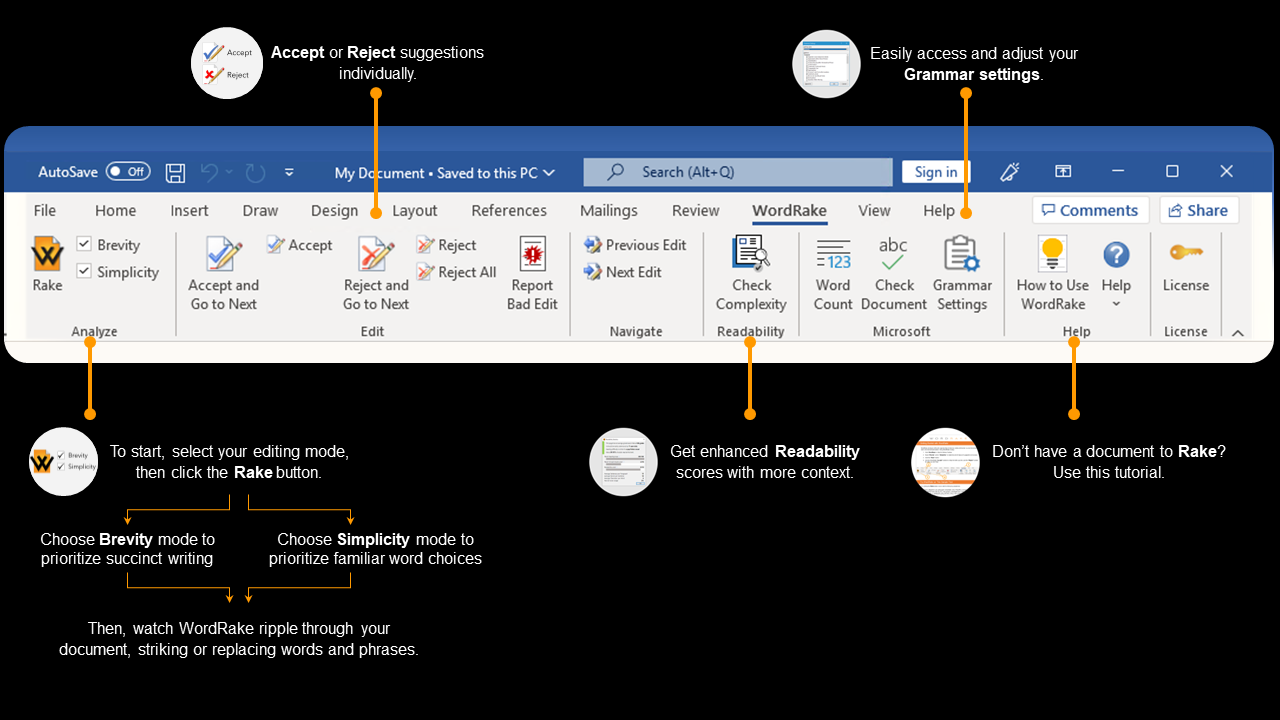
Want to see more examples? Visit our software page
What our customers are saying


I ‘raked’ a 25-page operating agreement in 30 seconds, resulting in 60 insertions and 140 deletions. WordRake is perfect for anyone who wants their writing to be less verbose and more persuasive.

I searched for a comparable editing program, but couldn't find anything like it. WordRake should become a staple in any government agency.

I have been using WordRake for at least four years. I use it for all of my writing. It is not a grammar check like word has. It helps you tighten up your text and presents better ways to say what you want. It is amazing. For $129 a year, you wont believe how good it makes you look.

As a privacy and data security attorney, I trust WordRake with my documents. WordRake is the perfect tool to remove legalese and cumbersome language. With its help, the privacy notices I’ve drafted are some of the most readable online. I’m comfortable using WordRake because the content of my documents never leaves my computer.

WordRake provides an in-house editor to any professional who wants to clarify and strengthen their writing. Run it through a document and watch it catch flimsy phrases and cluttered clauses that keep readers from your intended meaning. Not only does it elevate your sentences' clarity, but it instills greater confidence as a writer, helping you identify bad writing habits you can learn to leave behind. I recommend WordRake to anyone working with words.

Concise, professional writing skills require constant reinforcement and WordRake delivers. WordRake teaches better writing habits by offering editing suggestions that you must review and accept or reject. It’s exactly the feedback and training I searched for when I was a paralegal drafting documents with little guidance. Now that I run a company dedicated to helping firms become efficient, I recommend WordRake licenses for everyone!
Love this experience? Try WordRake on your own documents now!
Download your 7-day free trial here.
No credit card required.
WordRake is available for Word on Mac and Windows. WordRake is also available for Outlook on Windows.
- Operating Systems: Monterey, Ventura, Sonoma, Sequoia, and Tahoe
- Applications: Microsoft/Office 365*, MS Word 2024, 2021, 2019, or 2016
- Operating Systems: Windows 11, 10, 8, 7, Server 2022, Server 2019, Server 2016
- Applications: Microsoft/Office 365*, MS Word and/or Outlook 2024, 2021, 2019, 2016, and 2013